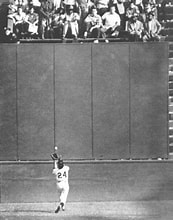
Baseball legend Wille Mays died yesterday at the age of 93. After starring in the Negro Leagues Mays went on to have a 23-year Hall-of-Fame career with the Giants finishing up back in New York with the Mets in 1973. Along the way Mays earned two MVP awards, batted over .300 ten times and when he retired, he was second only to Babe Ruth in career home runs with 660. He is now sixth on the all-time home run list. Willie appeared in three World Series, winning for the New York Giants in 1954 against the Cleveland Indians where he made his world-famous catch of Vic Wertz’s 425-foot blast in the first inning of game one. “The Catch” as it has been called ever since propelled his Giants to victory in five games.
But what I remember most about Willie Mays is how he tormented the American League in All Stars games throughout the 1960’s. Being from New Jersey I rarely got to see Mays once the Giants moved to San Francisco in 1958. But I did see him in the Nationally televised All Star Games. I was a devoted Yankee fan and thus an American League fan and when the All Star Game rolled around every July I fervently rooted for the American League, which was routinely battered in those days by the National League and especially terrorized by the “Say Hey Kid”. I vividly remember that the 1960 All Star game in my home ballpark Yankee Stadium was ruined by Mays as he hit a third inning home run against my favorite pitcher Whitey Ford. The AL went on to suffer a demoralizing loss 6-0 with my hero Ford taking the loss.
The NL’s battering of the AL continued through the sixties and once again Willie Mays was in the forefront in 1965. That game, in Metropolitan Stadium, featured a National League team which was so good they had Mays leading off! Whether they were showing off or just trying to rub it in, us American League fans knew we were in for a rough day with the game’s best slugger leading off followed by the likes of Hank Aaron, Willie Stargell, Ernie Banks and Pete Rose. And sure enough the “Say Hey Kid” promptly led off the game with a home run against Milt Pappas and my AL was doomed again. Mays of course scored the winning run in the seventh inning of what turned out to be a close 6-5 loss for the AL.
Throughout the sixties the NL won 12 of 15 All Star games with Willie Mays leading the way. Having been tormented by him all those years I eventually came around to appreciate what a remarkable ball player and incredible human being Willie Mays really was. The world has suffered a great loss with the passing of Willie Mays. RIP.
A few weeks back I was fortunate to attend a wonderful event by The Carriage House Poetry Series in my town of Fanwood. The event featured readings by Edwin Romond the author of five collections of poetry. I had recently finished some research on Hank Aaron and a post that you may have read about the anniversary of his momentous achievement breaking Babe Ruth’s home run record. One of Ed’s poems was about that very event and he gave me permission to post his wonderful poem here.
BreakingIn memory of Hank Aaron (1934-2021)
1953 in Washington, DC Hank Aaron could see the Capitol Dome, glistening symbol of freedom, through windows of the cafe where he and his black teammates had just finished breakfast. After the waitress took their plates to the kitchen he heard glassware breaking, smashed so no one else would use them, so no one else would eat from plates that had touched the forks that had been in the mouths of black American men.
But Hank would answer hate with excellence playing baseball with graceful greatness through the 50’s, 60’s and, on one Atlanta night in ’74, did his own breaking, smashing #715, one more homer than Babe Ruth whose record stood unshattered for five decades. And in 2002 Aaron returned to Washington, DC this time to stand in the White House, just blocks from that cafe, to receive the “Presidential Medal of Freedom” from George W. Bush and as the East Room audience stood and cheered, Hank’s face broke into a grand slam smile before sitting down to dine on the First Family china.
This poem can be found in Ed Romond’s award-winning poetry collection “Man at the Railing” published by NQY Bookshttp://www.nyq.org
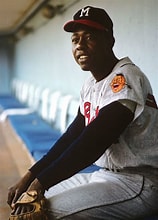
It was fifty years ago today that Hammerin’ Hank Aaron hit his 715th home run surpassing Babe Ruth’s long-standing record for lifetime home runs. On that cool early April afternoon in 1974 in Atlanta Stadium Aaron blasted a deep fly ball over the left-field wall against LA Dodger lefty Al Downing and became Major League Baseball’s all-time home run king.
I remember watching the momentous event with a small group of my college buddies. Yes, we cut classes to watch it. We had our priorities in order, although we were thankful that Hank came through that day saving us any further conflicts with our priorities.
Growing up a Yankee fan in the northeast in the 50’s, 60’s and 70’s I didn’t get to see Aaron on a regular basis. But I’ll never forget attending a mid-60’s game at Shea Stadium, Mets against the Braves. We had great seats in the loge section courtesy of the corporate perks of my buddy’s father. I distinctly remember being in awe of Aaron. He had an almost regal presence as he slowly ambled up to the plate. He had an unusual habit of carrying his helmet to home plate and then slowly donning it over his cloth hat as he settled into the batter’s box. He would then take one or two practice swings flexing his powerful wrists. Aaron was known for his powerful wrists. (As kids and wannabe ball players we actually did Hank Aaron inspired exercises to strengthen our wrists.) Then with a flick of those wrists Aaron treated us with a long home run. One of his 755 lifetime home runs. Most of us at that time thought it would be Mickey Mantle or Willie Mays who would pass the legendary Babe. But looking back on it, if my college self could tell my teenage self, “Hey, Hammerin’ Hank just passed the Babe,” my teenage self would have said, “Wow! Hey, I knew he could do it!”
Hank Aaron’s 23-year Major League Baseball career spanned three decades playing for only two cities, Milwaukee, and Atlanta and only two teams the Braves for 21 years and his final two years in 1975-76 with the Milwaukee Brewers.
He is the all-time leader in RBI’s, extra base hits, and total bases. He is second in lifetime home runs to Barry Bonds and second in at bats to Pete Rose. During his Hall of Fame career, he led the National League in home runs four times, RBI’s four times and batting average twice.
In 1957 he won the National League MVP award while leading the Braves to a World Championship over the New York Yankees.
Hank Aaron passed away in 2021 at the age of 86.
Many regard Aaron as the best professional baseball player of all time.
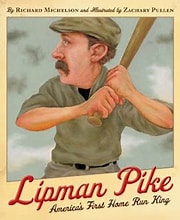
Few realized that baseball history would be made on July 16, 1866, a sweltering, humid afternoon, when the Philadelphia Athletics took the field against the Alerts of Danville at their new ball grounds in the City of Brotherly Love. Just a year earlier, the field served as a bivouac and staging area for the Union Army in the waning days of the Civil War. Up to the plate stepped 21-year-old Brooklyn native Lipman Pike, the son of Jewish refugees from Holland and the fastest, strongest player on the Athletics squad. Pike clouted the first pitch he saw deep to the gap in center field, using his tremendous speed for an inside-the-park home run. In each of his next four at-bats, Lip deposited the ball over the right field fence onto Columbia Avenue. Standing only 5’ 8” and 158 pounds, Lipman Pike was a veritable David amongst Goliaths, hitting five home runs in five consecutive at-bats in one game – a feat that hasn’t been matched in 158 years.
A local newspaper published that Pike, and two other players were paid $20 per week under the table by the Athletics, violating the amateur status of the “gentlemen’s sport”. Pike was ordered to appear before the governing committee of the National Association of Base Ball Players. The matter was dropped when no one from the Association bothered to show up for the hearing. As a result, Lipman Pike is considered one of the first professional athletes in America. Lipman Pike went on to a storied career as professional baseball’s first slugger, first Jewish player and manager, and the first American Jew to gain national fame as a sports icon. Tales of his feats became the stuff of legend. 1871 was the first year of the first professional baseball league, the National Association. Lipman Pike signed to play with the Troy Haymakers, who named him their captain and field manager – the first and only Jewish manager in baseball for the next 71 years. Pike led the National Association in home runs in 1871, 1872 and 1873, hitting 17.2 percent of the home runs swatted in the league in 1872, a record not broken until Babe Ruth in 1920. He holds the all-time career records for home runs and extra base hits in the National Association and won the home run crown in the National League in 1877, its second year of existence.
This newspaper photo from 1866 features the Brooklyn Atlantics and the Philadelphia Athletics of the National Association of Base Ball Players. Pike is one of the mustachioed players though I’m not sure which one.
Pike was one of the fastest men in baseball. He would race any challenger for a cash prize and a side bet. In 1873, Pike raced against a trotting horse named Clarence in a 100-yard sprint at Baltimore’s Newington Park and won by 4 yards in a time of 10 seconds flat, earning $250 (worth about $6100 today). While playing a game at Lakefront Park in Chicago in 1878, Lip Pike hit the longest double in major league history. Pike’s blast not only cleared the fence, but also a freight shed and half a dozen railroad cars, landing in a freight car traveling east. The Cincinnati Enquirer estimated the ball flew 600 feet, but legend has it that it traveled another 482 miles by rail. Due to the ground rules at Lakefront Park, Pike was only credited with a double. A few years later in Albany, Pike hit a ball over the wall at Riverside Park into the river. Right fielder Lou Knight began to go after the ball in a boat, but finally gave up. This time, in spite of the ground rule, Pike was credited with a home run.
His baseball career over, Lipman Pike became a successful haberdasher in Brooklyn, where he was beloved and celebrated by the Jewish community. Lip’s haberdashery became a successful business and a meeting place for the local baseball cognoscenti. There was an outpouring of grief after his death from heart disease in 1893 at the age of 48. The Sporting News wrote: “Pike . . . was one of the few sons of Israel who ever drifted to the business of ball playing. Called out by Umpire Death . . . Lip Pike was one of the greatest sluggers who ever batted.”
In the inaugural election for the Baseball Hall of Fame in 1936, Lipman Pike received one vote. He may not have a plaque in Cooperstown, but never fear. Lipman Pike, this pioneer who held many of early baseball’s firsts, who as a young man lived up to the nickname bestowed upon him, “The Iron Batter”, became professional baseball’s first legitimate slugger. He was a 19th century ballplayer whose prowess on the ballfields reflected the pride and hope felt by America’s most recent immigrant influx, Jewish people. In 1985, one hundred nineteen years after he hit 5 home runs in 5 consecutive at-bats in a game; ninety-two years after he succumbed to heart failure, Lipman Pike was decisively elected to a place of honor on the bimah of the Jewish Sports Hall of Fame in Netanya, Israel. You know how to get to the Jewish Sports Hall of Fame? Start out in Cooperstown and when you can’t find a Lipman Pike plaque, take a hard right and travel 6,000 miles straight to Netanya.
One of my favorite blogs is Archived Innings by Precious Sanders. While recently going through some past posts on Archived Innings I came upon a post honoring Buck O’Neil the talented Negro League ball player who had just been elected to the Baseball Hall of Fame. I have always been a fan of Buck O’Neil since I first learned about him watching Ken Burns’ documentary series Baseball. O’Neil was interviewed in the documentary and his stories about playing in the Negro Leagues were both enlightening and entertaining. He had such a warm and ingratiating personality I became an instant fan.
O’Neil was born in Carrabelle Florida in 1911 and became a steady if not spectacular first baseman for the Kansas City Monarchs, one of the best teams in the Negro Leagues. He had a lifetime batting average of .311. After his playing days were over, he became the first African American to coach in the Major Leagues. He was instrumental in the establishment of the Negro Leagues Baseball Museum in Kansas City, Missouri.
For his on-field accomplishments and his extraordinary contributions to the game of baseball O’Neil was posthumously elected to the Baseball Hall of Fame in 2022. The following video is a round table discussion about that long overdue event. The remarkable panel includes Bob Kendricks curator of the Negro Leagues Museum, filmmaker Ken Burns, writer Joe Posnanski, sports announcer Bob Costa and former Major League pitching star CC Sabathia. It is a wide-ranging discussion that covers much of O’Neil’s inspiring life story, the Negro Leagues, and the eventual integration of Major League Baseball.
I hope you’ll take the time to click on the discussion and watch it in full. I do caution however that the discussion starts off slowly. The first fifteen minutes consists of long-drawn-out praise of O’Neil which, though justified, becomes a bit repetitious. There is also too much discussion about the delay in finally inducting O’Neil. But once you get by that the discussion is thoughtful, insightful, and entertaining in which the commentators bring to life a truly fascinating and vitally important slice of American History.
(As the dreary days of winter drag on and Opening Day still seems so far away, I have found one antidote for these doldrums is to check out Gary Livacari’s excellent blog Baseball History Comes Alive. While doing so I came upon Gary’s fine retelling of this timeless baseball tale. I hope you enjoy it as much as I did.)
“I’ll knock a homer for Wednesday’s game. Babe Ruth” –Inscription on baseball scrawled by Babe Ruth during the 1926 World Series and given to little Johnny Sylvester, recovering from a near-fatal illness.
One of baseball’s most enduring legends occurred during the 1926 World Series. Of course it had to involve none other than the great Bambino himself. We’re all aware the Babe had his share of personal shortcomings (and don’t we all!); but when there was a kid in need, no one was more likely to come through in a big way than the Babe.
The Babe’s Famous Promise
The ball signed by Babe Ruth with his promise to Johnny Sylvester to hit a home run for him.
In 1926, little Yankee fan Johnny Sylvester was just 11 years old, recuperating from a horseback riding accident that resulted in a serious injury. He was hospitalized near his home in Essex Falls, New Jersey. The prognosis wasn’t good. The Yankees got wind of Johnny’s condition, and so during a rain delay in Game Three of the World Series in St. Louis, a few ball players signed a baseball just for Johnny. Babe Ruth inscribed more than just his signature, though. He penned his famous promise:
“I’ll knock a homer for you in Wednesday’s game” Babe Ruth
Babe visits the ailing Johnny Sylvester in the hospital.
In the classic photo above, we see the Babe and little Johnny together. Johnny still has a bandage on his forehead from his horseback riding injury. Thanks again to Don Stokes for another super colorization which really helps bring the story to life.
The Bambino Delivers…
On Wednesday, October 6, 1926 – Game Four of the series, a 10-5 Yankee victory – the Babe delivered on his promise…and then some! Amazingly, he didn’t hit just one homer, he hit three. On the day after Game Seven, Oct. 11, Ruth personally visited Johnny Sylvester in the hospital in Essex Falls.
…And Johnny Miraculously Recovers!
And sure enough, something miraculous happened: Against all odds, Johnny’s health gradually started to improve. According to Andrew Lilley, Johnny’s great-nephew, the visit from the Babe changed everything:
“Babe Ruth’s home runs and his visit helped Johnny find the will to survive.”
On Dec. 16, 1926, Ruth penned another letter to the boy (shown at right, in Babe’s distinctive, florid handwriting), inquiring about his recovery and inviting him to Yankee Stadium during the 1927 season “to help win another pennant.”
Johnny didn’t just survive…he thrived. He went on to graduate from Yale University in 1937, and later became a successful business owner and much-beloved family man. He even served in the Navy during World War II, rising to the rank of lieutenant. All because the Babe saved his life…or so the story goes!
Life Turns Full Circle!
In 1947, Johnny Sylvester visits an ailing Babe Ruth.
Fast forward to 1947. The situation had now completely reversed. Now it was Babe Ruth who was ailing and it was Johnny Sylvester’s turn to repay the man who had come to his bedside when he was gravely ill. As Andrew Lilley described the scene:
“The story had come full circle at this point. Here was the kid all grown up going back to the Babe and showing the same generosity to his hero, just as the Babe showed him all those years ago.”
Reading about this reunion 75 years later, it’s still hard not to shed a tear…
Ruth wasn’t the only sports celebrity to reach out to the ailing boy. “Big Bill” Tilden, one of the greatest tennis players of all time, sent him an autographed tennis racquet. Hall-of-Fame halfback Red Grange sent a letter and an autographed football. Baseball Hall-of-Famer Rogers Hornsby, in a rare show of compassion, was another famous athlete who sent little Johnny a letter. Of course, none of these other displays of concern did as much for little Johnny’s recovery as the Babe’s fulfilled promise and later visit.
Forty Years Later, Johnny Sylvester Is Found!
Johnny Sylvester at the time of his graduation from Yale in 1939
In 1986 – the 40th Anniversary of the Johnny Sylvester story – the Babe Ruth Museum tried to investigate the story for authenticity. The museum eventually tracked down the real Johnny Sylvester, finding him as a retired banker living in Connecticut. When asked for some proof that these events actually happened, Mr. Sylvester produced the baseball with Babe’s handwriting and signature. The ball said, “I’ll knock a homer for Wednesday’s game. Babe Ruth.” The ball is now on display in the Babe Ruth Museum in Baltimore along with the other artifacts in “The Little Johnny Sylvester Collection.” It’s been on loan to the Babe Ruth Museum for 36 years.
The Babe Ruth Museum located Johnny Sylvester in 1986.
But Is the Story True?
Is this heartwarming story completely true, or has it been embellished? Was the whole thing a hoax? Maybe we’re falling for a sappy publicity stunt dreamt up by Babe Ruth’s ubiquitous agent and “image-maker,” Christy Walsh. It certainly has that ring to it.
If so, it was highly successful. The publicity was priceless for Babe Ruth’s image. Years later when asked about the incident, Ruth is purported to have blurted out, “Who the hell is Johnny Sylvester?”
True or not, it remains one of the most timeless anecdotes in all of baseball lore and is one of the wonderful stories contributing to the endearing legacy of the great Bambino, Babe Ruth. Sadly,Johnny Sylvester passed away on January 6, 1990 at age 74 while residing in Garden City, New York.
Gary Livacari
Subscribe to our website, “Baseball History Comes Alive!” with over 1200 fully categorized baseball essays and photo galleries, now closing in on the one million hits mark with 899K hits and over 700 subscribers: www.baseballhistorycomesalive.com
As Jim Plamer celebrates his 78th birthday today he, like all his fellow Baltimore Orioles fans, share the disappointment of a super season that ended too quickly. Though the Orioles made it to the playoffs for the first time since 2016 their failure to reach the World Series, despite having the best record in the American League, is hard to accept. Nonetheless it is a good time to recognize the achievements of their Hall of Fame hurler.
Since moving to Baltimore in 1954 the Orioles have made it to six World Series and have won half of them. Remarkably, Jim Palmer appeared in all six of them and he is the only pitcher in World Series history to record wins in three different decades.
Palmer’s first appearance in the World Series was a stunning success. In 1966, nine days before his 21st birthday, he faced off against the Los Angeles Dodgers’ stellar southpaw, Sandy Koufax in game two. The upstart Orioles had shocked the defending World Champion Dodgers with a 5-2 victory in the opener when the Robinson boys, Frank and Brooks, hit back-to-back home runs in the first inning against LA ace Don Drysdale. Even more remarkable, the unheralded reliever Moe Drabowsky pitched 6.2 scoreless innings to secure the victory. Surely Koufax would avenge that opening loss in game two. Afterall, Koufax was the premier pitcher in the majors after another fabulous season with 27 wins and a 1.73 ERA. But the young Palmer wasn’t fazed a bit and cruised to a 6-0 shutout aided by an astonishing six LA errors. Ironically Palmer became the youngest pitcher ever to record a shut out in the World Series on the very day of Hall of Famer Sandy Koufax’s last game. Koufax retired at the end of 1966 due to an arthritic left elbow.
Palmer would go on to record World Series victories against the Reds in 1970 and the Pirates in 1971. In the 18th year of his 19-year career Palmer pitched in relief against the Philadelphia Phillies in game three of the 1983 World Series. He entered the game in the fifth, pitched two shutout innings retiring four fellow future Hall of Famers, Joe Morgan, Tony Perez, Mike Schmidt, and Steve Carlton and earned the victory. Palmer wound up with a World Series record of 4-2 with a 3.20 ERA. For his career Palmer recorded 268 wins versus 152 losses and a 2.86 ERA. He won the American League Cy Young award three times in 1973, 1975 and 1976.
The Baltimore Orioles World Series appearances:
1966: won in four games against the Los Angeles Dodgers
1969: lost in five games against the New York Mets
1970: won in five games against the Cincinnati Reds
1971: lost in seven games against the Pittsburgh Pirates
1979: lost in seven games against the Pittsburgh Pirates
1983: won in five games against the Philadelphia Phillies
On a personal note: I’ll always remember Palmer for his high leg kick, rising fastball, sweeping curve and the way he dominated my Yankees in the late sixties and throughout the seventies. As an American League fan, I rooted for Palmer and the Orioles in those six World Series and was ecstatic with the way he handled the Dodgers in 1966. The Orioles were big underdogs that year and nobody expected them to matchup against the tremendous LA pitching. But when they did, with a four-game sweep, I was nothing but smiles.
References:
Baseball Almanac
Baseball-Reference.com
A History of the World Series, The Grandest Stage by Tyler Kepner
This year marks the 25th anniversary of what could be regarded as the best baseball team of all time, the 1998 New York Yankees. In his new book The Inside Story of the Greatest Baseball Team Ever The 1998Yankees author Jack Curry makes a convincing case. If you are a baseball fan and you haven’t read Curry’s book you should. If you are a Yankee fan you must.
As a long time Yankee fan, I didn’t need much convincing, though I had to do some research on the 1961 Yankees, the team I grew up watching, to make sure Curry’s argument held up. And it does. It also holds up against all the other great teams in baseball history. By all means get Curry’s informative and enjoyable book to see his complete argument. For my blog here I will focus in on what I believe are the most important facets support the conclusion that the 1998 New York Yankees are the best team ever.
First, to set some parameters: I am not talking about the best collection of players, nor am I measuring the team over a course of several seasons. I am not talking about a dynasty team (though the 1998 Yankees were part of a dynasty team that won four World Championships and five AL Pennants over the course of 6 years; 1996-2001). I’m talking about a team having the greatest single season ever. And for this I believe there is no doubt.
The two most important categories to consider are wins, of course, and winning the World Series. A lesser category would be winning percentage.
Let’s start with winning percentage as the fairest way to differentiate a really good team from a great team. Afterall, winning percentage accurately accounts for the significance of the different lengths of seasons from baseball’s different eras. Specifically, the change from 154 games to 162 games which occurred in 1961. Using .700 as the dividing line we find nine teams in modern baseball history (since the beginning of the World Series in 1903) that had a regular season winning percentage over .700.
Here is the list:
1906 Chicago Cubs .763 W 116 L 36
1909 Pittsburgh Pirates .724 110-42
1954 Cleveland Indians .721 111-43
2001 Seattle Mariners .716 116-46
1927 NY Yankees .714 110-44
1998 NY Yankees .704 114-48
1931 Philadelphia Athletics .704 107-45
1907 Chicago Cubs .704 107-45
1939 NY Yankees .702 106-45
Of these nine teams four can be eliminated because despite their fantastic regular season they failed to win the World Series. In my book you can’t be considered the best team ever if you couldn’t even win the championship. So, despite having the most regular season wins at 116 both the 1906 Cubs and the 2001 Mariners are both eliminated because they failed to win the World Series. The Cubs lost to their crosstown rivals the White Sox and the Mariners failed to even make it to the World Series, losing in the playoffs to the Yankees. The 1954 Indians and the 1931 Athletics also failed to win the World Series so that leaves us with five teams remaining.
Honus Wagner
This is a tough call, but I’m going to eliminate the 1909 Honus Wagner led Pittsburgh Pirates because they had a difficult time in the World Series needing seven games to beat Ty Cobb’s Detroit Tigers. The remaining four teams all went undefeated in the World Series although the 1907 Cubs took five games to defeat the Tigers with one game ending in a tie.
To differentiate the four remaining teams, I will use a rough metric from the Baseball Almanac where the teams’ yearly stats are compiled showing the leaders in ten offensive categories such as batting average and runs and eight pitching categories such as ERA and strikeouts. The best team here is the 1927 Yankees who led in 12 categories, the 1939 Yankees 10 categories, the 1998 Yankees eight categories, and the 1907 Cubs only five categories. Using this metric, I will give the 1907 Cubs with the lowest score the boot leaving the three Yankee teams as the finalists. I know, I’m a Yankee fan, but what can I say, the stats don’t lie.
The Baseball Almanac’s metric has however a significant flaw. It can’t account for a major difference between the two eras; before and after the leagues expanded. The 1998 Yankees competed against twice as many teams as the 1927 and 1939 Yankees, thus it was much more difficult to lead in a category. But we can use that metric to compare the 1927 Yanks and the 1939 Yanks, and we can give Babe Ruth’s Yanks the nod over Joe DiMaggio’s lower scoring Yanks, thus eliminating the 1939 Yanks and leaving just the 1998 Yankees and the 1927 Yankees in the competition.
Lou Gehrig and Babe Ruth
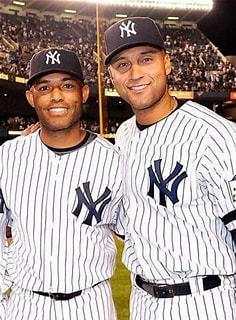
So, comparing two teams from two different eras can be difficult but it also can be fun. I know growing up and watching the 1961 Yankees every day; as the season went on there were discussions as to whether the 1961 Yankees with the M&M Boys, Mantle and Maris, could compare with Ruth and Lou Gehrig and the Murders Row of 1927. At that time the 1927 Yankees were considered the best team of all-time, at least in my neck of the woods and without any advanced metrics. The ’27 Yankees certainly had all the power and glitz with two of the all-time greats in their lineup, Ruth, and Gehrig. The ’98 Yankees didn’t lack in star power with two emerging Hall of Famers, Derek Jeter, and Mariano Rivera on their roster. They also had the AL batting champ Bernie Williams and a solid pitching staff with borderline Hall of Famer David Cone, plus Andy Pettitte and David Wells. As a result, I must contend that it all comes down to wins. The 1998 Yankees, winning 114 regular season games and 11 post season games for a total of 125 wins, had more wins than any other team ever, and 11 more than the 1927 Yankees. Now you could argue that if the 1927 Yankees played 23 more games, they probably could have won at least 12 of them. The problem is, that would be mere speculation and there is no way to know, and we will never know. There is no other way around it, the 1998 New York Yankees, winner of 125 games, are simply the best.
Mariano Rivera and Derek Jeter
A couple of footnotes.
One reason the 1998 New York Yankees do not get the credit they deserve is that the year 1998 in baseball is primarily remembered for the incredible home run competition between Mark McGwire and Sammy Sosa. As the Yankees dominated the American League with record setting precision, McGwire and Sosa were captivating the entire nation with their quest to break Roger Maris’s single-season home run record. Prior to any suspicions of PED’s they were America’s sports heroes as McGwire blew by Ruth and Maris with 70 home runs and Sosa doing the same with 66.
Curry’s book also mentions a comparison of the greatest teams done by the website FiveThirtyEight using a complex set of metrics. FiveThirtyEight lists the 1939 Yankees as number one, kudos to Joe D, but the ’39 Yanks had the lowest winning percentage of our nine .700 teams, and it somehow rates the 1906 Cubs number two despite losing the World Series. For those reasons I believe their metrics are flawed. They even dropped our 1998 Yankees to fifth, behind the ‘27 Yankees and the ’09 Pirates which I certainly find unjustifiable.
References:
The Inside Story of the Greatest Baseball Team Ever The 1998 Yankees by Jack Curry
Last night New York Yankees’ righthander Domingo Germán pitched a perfect game against the Oakland Athletics in the Oakland Coliseum. It was only the 24th perfect game in major league history and the first since 2012. The flawless Yankee hurler used only 99 pitches to set down the A’s compiling 9 strikeouts in the process. He used an awesome curveball fifty percent of the time and completely corralled the Oakland batting order. For the most part it was an easy game for the Yankee defense with only a nice, backhanded stop by first baseman Anthony Rizzo needed to preserve the gem. The New York offense came to life providing 11 runs, the most ever in a perfect game. Yankee manager Aaron Boone called Germán’s performance a masterpiece. Catcher Kyle Higashioka agreed saying it all came together for Germán and he was amazing. What is most surprising is that Germán had been awful in his last two games allowing 17 runs in 5 innings. He is the only pitcher ever to pitch a perfect game after giving up ten runs in his prior game. But that was all in the past as the crafty Dominican was in complete control last night.
It was the fourth perfect game pitched by a Yankee. The first one was the memorable performance by Don Larsen in game five of the 1956 World Series against the Brooklyn Dodgers. Almost 43 years later in 1998 David Wells spun a perfect game on Beanie Baby Day at Yankee Stadium. David Cone followed up the next year with a perfect game against the Expos. Ironically that performance occurred on Yogi Berra Day at the Stadium and Larsen was in attendance.
Germán, having been born in the Dominican Republic, is only the third pitcher born outside of the USA to pitch a perfect game; Félix Hernández in 2012 for the Seattle Mariners was born in Venezuela and Dennis Martínez in 1990 pitching for the Montreal Expos was born in Nicaragua.
Of the previous five perfect games three came in 2012 and two in 2010. Hernández pitched his against Tampa Bay on August 15, 2012, Matt Cain against Houston on June 13, 2012, and Philip Humber against Seattle on April 21, 2012. The perfect games hurled in 2010 were by Roy Halladay against Miami on May 29 and Dallas Braden against Tampa Bay on May 9.
It seems as if perfect games occur in bunches so be on the look-out this year!
On a personal note, those of you who are into Fantasy Baseball will appreciate this. Domingo Germán is on my fantasy team and based on his recent miserable performances I strongly considered benching him this week. But I saw that his start this week was against Oakland, the team with the worst offense in the majors. For that reason, fortunately, I kept Germán active this week. What could be worse than to have one of your fantasy pitchers inactive while pitching a perfect game? Whew! That was a close one.
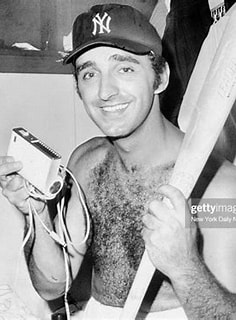
Former Yankee star Joe Pepitone passed away Monday at the age of 82. Born in Brooklyn, Pepi, as he was known, brought style and pizzazz to the staid New York Yankees when he arrived on the scene as a brash rookie in 1962. He was known as much for his waves of dark hair as he was for his power hitting and slick fielding. He shocked the major leagues by bringing a hairdryer into the locker room and though the world may have been on the edge of nuclear war, Pepi stole the headlines with his blow-dried locks.
Pepitone’s emergence allowed the Yankees to trade away their solid first baseman Bill Skowron at the end of the ’62 season for Dodger pitcher Stan Williams. Pepi then took over first base and had several fine seasons for the Bombers. He was a three-time All-Star and helped lead New York to two American League Pennants in 1963 and 1964. He averaged 23 home runs a season over his seven years as a starter for New York and earned three Gold Gloves for his exceptional play at first base. Remarkably, it was Pepi who took over in centerfield when the hobbling Mickey Mantle moved to first base in 1967.
My most searing memory of Pepitone came in the 1963 World Series. It was game four and the Yanks were up against the wall, down three games to zero to the LA Dodgers. The Dodgers had extraordinary pitching that year led by the unhittable duo of Sandy Koufax and Don Drysdale. Koufax was pitching another masterpiece in game four, matched by a superlative pitching performance by Whitey Ford. Trailing 1-0 in the top of the seventh, Mantle gave New York hope with a game-tying home run. But in the bottom of the seventh disaster struck for the Yanks. Jim Gilliam hit a routine ground ball to Clete Boyer at third, but Pepitone at first base astonishingly failed to catch the cross-diamond throw from Boyer. The throw hit the heel of Pepitone’s glove and bounded far enough away to allow Gilliam to go all the way to third. Tommy Davis then knocked in Gilliam with a sacrifice fly and Koufax sealed the 2-1 victory for the Dodgers with two scoreless innings in the eighth and ninth. Pepi later explained that he momentarily lost Boyer’s throw in the light-colored shirts of the sundrenched fans behind third base. It was a crushing way to end the series even though New York was thoroughly over-matched by the LA pitching.
Pepitone somewhat redeemed himself in the 1964 World Series with a big grand slam home run against the Cardinals leading New York to a win in game six. Ultimately Pepi’s time ended in disappointment with the Yankees. Known as the “Prince of Potential” or “a poor man’s Joe Namath” the glamour boy never reached the heights of stardom hoped for by Yankee fans. After their AL pennant in 1964 the fortunes for the Yankees faded as did those of the flashy young phenom named Joe Pepitone.
Pepi finished his career playing with modest success for the Chicago Cubs. After he retired in 1973, he became a fixture at Yankee Old-Timers’ games and his warm personality and delightful sense of humor continued to charm Yankee fans. He will surely be missed.
RIP # 25
References:
Baseball Almanac, Baseball-reference.com, Alan Zevin/NYTimes










 Back Home With Baseball and Beyond
