Last night Alyssa Nakken became the first female in baseball history to appear on the field during a major league game as she took over the first base coaching duties for the San Francisco Giants. She took over when Antoan Richardson was ejected from the game in the third inning. Nakken was greeted with a warm handshake at first base by San Francisco base runner Eric Hosmer. The Giants went on to beat the San Diego Padres 13-2.
The historic moment was a long time in the making. Nakken, 31, had a stellar collegiate career winning the National Fastpitch Coaches Association Scholar-Athlete grant multiple times. She was also on the Pacific Coast Softball Conference Commissioner’s Honor Roll multiple times. She was the Scholar Athlete of the year while attending Sacramento State in 2012.
Hired by the Giants in 2014 as an intern, through determination and hard work she earned her way to a fulltime coaching position in 2014 becoming the first female to reach that position.
Nakken’s historic moment was preceded earlier this month by the first appearance of a female manager in an MLB-affiliated game when Rachel Balkovec took the reins for the New York Yankees’ Single A Tarpons.
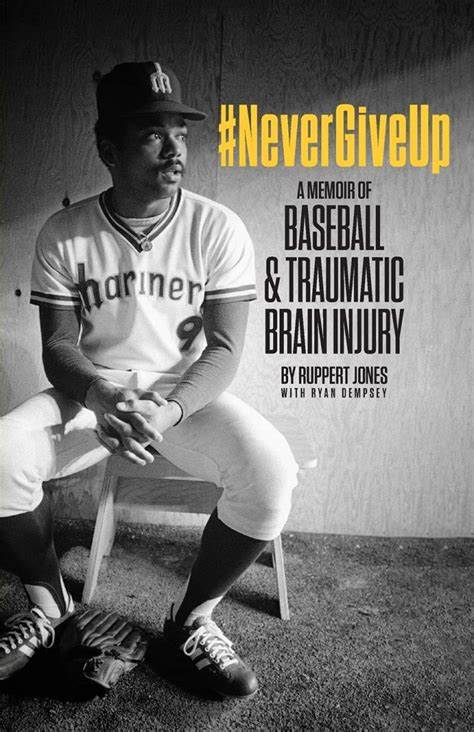
Ruppert Jones was an extremely talented and hard-working baseball player who made it to the major leagues with the Kansas City Royals in 1976. He was soon acquired by the new Seattle Mariners as their number one draft choice when Major League Baseball expanded in 1977. Jones went on to have several fine seasons and was the first Mariner to be selected to the American League All Star Team. He was a tremendous defensive outfielder who had a rare combination of speed and power, but his career was cut short by several injuries that he suffered. The worst of which occurred while playing with the New York Yankees in August 1980 when Jones crashed into the unpadded outfield wall in the Oakland Coliseum trying to chase down a long blast by Tony Armas. The effects of that injury went undiagnosed for many years as Ruppert’s talents deteriorated and his personal life suffered.
But as his title indicated Jones never gave up. He continued to have productive years in baseball, at one point helping the Detroit Tigers to the World Championship in 1984, but his major league career finally ended in 1987. It is at this point that the full importance of this memoir picks up. As Jones’ life spiraled out of control, he desperately searched for answers to the devastating effects of his loss of cognitive functions due to his head injury. To make matters worse he found himself self-medicating with drugs and alcohol.
His memoir then continues as part mystery and part love story as Ruppert searches for answers with his loving wife Betty always at his side. It is a long and difficult journey, but Jones eventually finds answers and begins an effective treatment plan.
What is remarkable about this book is that traumatic brain injury is usually only associated with football. But Jones that is not always the case. He points out that traumatic brain injury can happen in baseball, soccer and many other walks of life and it can be terrible if it is not diagnosed properly and treated effectively. Ruppert Jones’s memoir is call for action to recognize and treat traumatic brain injury and is a testament that with determination and a “never give up” spirit even the worst afflictions can be overcome.
I highly recommend this well-written and inspirational book.
I recently received this book review for my novel Mickey Mantle’s Last Home Run. This is from OlineBookClub.org and is currently posted on their website.
Mickey Mantle’s Last Home Run by Steven A. Falco deserves a 4 out of 4 stars. There are different positive aspects of this book to justify this rating. First, the book is a product of good research and personal experience of Steven. This inference is made from the brief profile of the author on the last page of the book, which reveals that Steven had played baseball while growing up. Also, this book is professionally edited; I could only spot one error in it.
The book is a story of a 15-years old boy popularly known as T.J. who has a near-obsession with baseball. This book contains subplots that teach lessons against racial prejudice and discrimination. T.J’s obsession for the Mick makes him frequent Yankee Stadium, sometimes alone, with Jonathan, Frankie, and Phil, or at other times, with his father and brother. However, he breaks this practice when he has to wait at St. Patrick’s Cathedral, together with Jonathan, Maggie, and her friend, to pay his last respects to the slain Robert Kennedy.
Meanwhile, Jonathan devices ways to ease the pain of other students during boring classes by creating school clubs for interested students. The strife between the Blacks and the Whites is heightened when T.J mistakenly hit a Black kid named Darrell during baseball practice and when Martin Luther King Jr. was assassinated. T.J’s life is endangered as it seems that the Black kids would like to take revenge for both incidents on him. Will he survive this plan, or will he be assassinated like Robert Kennedy?
This book is exceptional, and it is recommended to young adults because there are lessons contained in the book that would be of help to them. Lovers of fictional books would also have a fantastic time reading this book.
By guest blogger, baseball historian and author Gary Livacari
“Bell was so fast he could turn off the light and be under the covers before the room got dark!”-Satchel Paige, speaking of “Cool Papa” Bell.
“We played a different kind of baseball than the white teams. We played tricky baseball. We did things they didn’t expect.” -“Cool Papa” Bell
“Bell was an even better man off the field than he was on it. He was honest. He was kind. He was a clean liver.” -Teammate Ted Page, speaking of “Cool Papa” Bell.
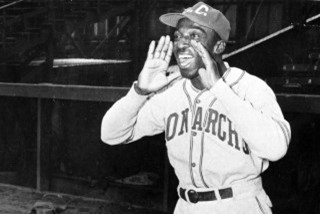
James “Cool Papa” Bell was an eight-time All-Star center fielder who played in the Negro Leagues from 1922 to 1950. He’s considered by many baseball observers to have been one of the fastest men ever to play the game. Legends about the “fast as lightning” Bell and his remarkable speed are still widely circulated many years after his playing days.
Cool Papa Bell
Bell was born May 17, 1903, in Starkville, Mississippi, the fourth of seven children. At age 17, he moved to St. Louis to live with older brothers and attend high school. Bell spent most of his time playing baseball instead of studying. In 1921 he signed as a
knuckleball pitcher with the Compton Hill Cubs, a black semipro baseball team. He played with Compton Hill on Sundays and holidays while working for a packing company during the week. For 1922, Bell moved to another semi-pro team, the East St. Louis Cubs, which paid him $20 weekly to pitch on Sundays.
Bell signed with the St. Louis Stars of the Negro National League as a pitcher in 1922. He earned his nickname in his first season. Teammates referred to him as “Cool” after striking out Oscar Charleston, and then he added “Papa” because he thought it sounded better. At first, Bell made only occasional appearances in the outfield. By 1924 he began working on his defense and utilized his great speed. Pitchers tried to avoid issuing him walks as he often stole both second and third. Bell was known to score from first after a base hit.
Bell bounced around to many teams, typical of Negro League stars. Teams included the Kansas City Monarchs, Santo Domingo of the Dominican League, the Mexican winter leagues, the Homestead Grays, and finally the Pittsburgh Crawfords of the reorganized Negro National League.
The 1932-36 Pittsburgh Crawfords, named after the Crawford Grill, are considered some of the greatest teams ever. Cool Papa Bell, along with teammates Ted Page and Jimmie Crutchfield, formed possibly the best outfield in Negro League history. On the 1936 team, Bell was one of seven players who was later inducted into the Hall of Fame. Check out these names: Oscar Charleton, Satchel Paige, Josh Gibson, Bill Foster, Judy Johnson, and Jud Wilson. The team also included stars Sam Bankhead, Jimmie Crutchfield, Leroy Matlock, and Ted Page. Bell finished his career with a .341 batting average and hit .391 in exhibitions against major leaguers.
Satchel Paige liked to relate stories about Cool Papa’s speed, especially a famous one from a hotel. Due to faulty wiring, there was a short delay between flipping a light switch off – and the lights actually going off. This was enough time for Bell to jump into bed after flipping the switch, and Paige’s famous quote about “Cool Papa’s” speed was born.
Another legend held that Bell once hit a ball up the middle and was struck by the ball as he slid into second base! He once circled the bases in 13.1 seconds on a soggy field in Chicago, claiming he did it in 12 seconds in dry conditions.
Amid all the tales of Bell’s speed, one aspect of his personality was never in doubt: his outstanding character, attested to by many who knew him.
1974 New Hall of Fame Inductees: Mickey Mantle, Whitey Ford, “Cool Papa” Bell, Jocko Conlan
Bell died on March 7, 1991, aged 87. He was elected to the Baseball Hall of Fame in 1974 by the Negro League Committee. In 1999 Bell ranked 66th on The Sporting News list of Baseball’s Greatest Players, one of five players so honored who played most of their careers in the Negro Leagues. He was also named to the Major League Baseball All-Century Team.
So today we gladly shine our baseball spotlight on Hall-of-Famer James “Cool Papa” Bell, one of the great stars from the Negro Leagues.
Gary Livacari
Subscribe to our website, “Baseball History Comes Alive!” with over 1200 fully categorized baseball essays and photo galleries, now surpassing the 700K hits mark at 769 hits: www.baseballhistorycomesalive.com
Photo Credits: All from Google search
Information: Excerpts edited from Cool Papa Bell Wikipedia page.
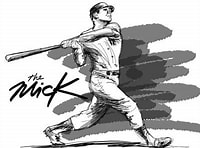
Artist James Fiorentino has been at the forefront of a developing trend highlighting the magnificent artwork that has always been a part of the trading card industry. He began painting trading cards for Topps in 1999 and was recently contacted by East Coast Sports Marketing to start a project to commemorate the most iconic baseball cards in history.
This new watercolor painting by Fiorentino of the 1952 Topps Mickey Mantle trading card captures and enhances the brilliance of this underappreciated corner of the artworld. The painting was on display at the “There is Only One, the Most Iconic Trading Cards of All Time” exhibition in The Philly Show last September. The Philly Show is the oldest baseball card show in America starting back in 1975.
I had the good fortune to visit with James recently and when I saw the 22 by 30-inch painting of the 1952 Mantle card I was blown away. For my generation this is the ultimate prize of the baseball card world. And as a lifelong Mickey Mantle fan the painting is truly heart stopping. I had read recently that this card, in mint condition, sold for almost $3 million dollars in 2018. But what really hit me was the sheer beauty of the painting and the understanding that both the original card and Fiorentino’s recreation are nothing short of and sports-art masterpieces.
Also on display in the show was Fiorentino’s recreation of the 1953 Topps Mickey Mantle trading card. According to James, “For me, this painting is the holy grail of the set because it’s always been the most iconic card (along with the Honus Wagner T206 card), so it was a painting that had to be very accurate. This is such a beautiful card to paint because of how the colors just pop. The aquamarine type background color with the yellow bat just give it that classic look. I have always loved the detail in the logo design, and the shot of Mantle as a young kid from the side is such a great pose, evoking a Paul Bunyan-type hero. This may be my favorite Mantle card of all time because of my affinity with the artist Gerry Dvorak, who originally painted this iconic card in 1953. Gerry was a friend and mentor, so it was an honor for me to work on this card. The entire 1953 Topps set is my personal favorite, with the large faces and classic red label. I have always loved the softer feel of the portraits in this set, as well as the brushstrokes you see on many of the cards. It’s another well balanced image, and great shot of a young Mickey Mantle.”
Fiorentino had several other watercolor paintings on display at the show which included the 2011 Topps Mike Trout card, the 1989 Upper Deck Ken Griffey Jr. card, the 1951 Bowman Willie Mays card, 1951 Bowman Mickey Mantle card and the 1933 Goudy Babe Ruth card.
The Series Two show has also been completed. The paintings displayed in both shows have been sold out. The Series Three show is being developed and should be scheduled soon.
James has been an incredibly talented artist all his life and through years of hard work and dedication has mastered the difficult watercolor medium. When growing up his two loves were painting and playing baseball. He still does both though his baseball playing has recently been limited to coaching little league with his two sons. Painting iconic baseball cards is just a small part of his portfolio which includes spectacular watercolors of super stars from all sports such as Tom Brady, Joe Namath, Michael Jordan, and Kevin Durant. He also does gorgeous wildlife paintings and luscious landscapes.
The 1984 baseball season is best known for the remarkable wire-to-wire performance by the American League pennant winners the Detroit Tigers. The Tigers then went on to beat the San Diego Padres easily in the World Series completing one of the most dominant team performances in recent baseball history. But as Detroit easily breezed to the pennant there was a dramatic and closely fought battle for the American League batting title. So close was this contest that it was fought by two teammates who batted third and fourth in the same lineup.
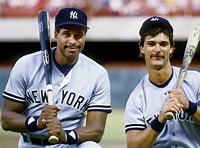
Dave Winfield and Don Mattingly, although both Yankees, were as different as one could imagine. Big Dave was the veteran, a star in his own right. Donnie (soon to be known as “Donnie Baseball”) was a second-year player trying to make his mark. Winfield, who had been acquired by the Yankees in 1981 in another splashy free agent signing by New York owner George Steinbrenner, was already a headline performer. As a four-time all-star in the National League, Winfield was expected to lead the Yankees to Championships throughout the 1980’s, but he got off to a shaky start when disputes arose with Steinbrenner regarding aspects of his contract. That combined with Winfield’s dismal performance in the 1981 World Series—an .045 average in a crushing defeat to the Dodgers—did not endear Big Dave to the New York fan base. Mattingly on the other hand was a fresh face having been brought up mid-season in 1983 and was showing great promise. It did however require the genius of Yankee manager and all-around sage Yogi Berra to believe in the young phenom and insert Mattingly as the Yankee first baseman right from the start of the season. Donnie Baseball would remain the Yankee first baseman and unrivaled fan favorite for more than a decade. And even their batting styles could not be more different. Winfield was a tall and lanky right-handed free swinger with tremendous power. Mattingly was a compact lefty hitter who stayed back on the ball and could send sizzling line drives to the gaps. It would be an intriguing and exciting contest.
As the year began Mattingly got off to a great start but Winfield struggled with a ham string injury. They both shifted into high gear by June when Winfield had a 17-game hitting streak and Mattingly countered with a pair of five-hit games. By the All-Star break Big Dave, who had cut down on his swing, surged ahead with a scintillating .370 average as Donnie Baseball trailed at .330. Through the dog days of August Mattingly slowly cut the deficit and with a five-hit performance against Seattle on August 25 he moved ahead of Winfield .352 to .350. September saw the duo continue to go neck and neck so the competition would ultimately come down to the last day of the season.
Big Dave
Donnie Baseball
On that warm September day, the last game of the season, Mattingly had definitely emerged as the fan favorite even though he trailed Winfield .341 to .339. Winfield’s continuing spats with Steinbrenner took its toll and, although Big Dave was about to finish one of his best seasons, the fans actually booed him when he came to plate. With all that good karma and a little bit of luck Donnie Baseball slashed his way to a 4 for 5 day, pushing his average to .343. Big Dave slumped to a 1 for 4 settling at .340 giving the batting crown to Mattingly. After the game in a classy display of sportsmanship the two teammates tipped their hats to the fans and posed for pictures.
Mattingly and Winfield would continue to be the heart of the Yankee team through the late 1980’s, both putting up impressive offensive numbers and playing fine defense. But the best New York could finish during those years was second place which they did in ’85 and ’86. Ironically the careers of both players later suffered setbacks due to back injuries. Winfield missed the entire 1989 season with back surgery and Mattingly was hampered by continuing back problems starting in 1990.
Big Dave finally escaped the wrath of Steinbrenner when he was traded to the California Angels in 1990 and then promptly put together a fine year winning the Comeback Player of the Year. He had a near MVP season with the Toronto Blue Jays in 1992 and redeemed his post season failures by helping to propel the Jays to their first Championship ever. His 11th inning double knocked in the winning run in game six.
Donnie Baseball never fully recovered from his back woes but continued his fine hitting, though without the power numbers he was accustomed to. His luck seemed to fade as did his power stroke and his dream for World Series play was dashed in his finally two years. First in 1994 when the Yankees’ first-place team was shut down by a late season labor dispute that cancelled the post season. Then in 1995, though still struggling with his bad back, Mattingly had a terrific divisional series batting .417 with 6 RBI’s but was stymied by the Edgar Martinez buzzsaw as the Seattle Mariners defeated the Yankees three games to two.
Although Mattingly preserved on that September afternoon in 1984 it seemed that Winfield would eventually come out ahead. In even another irony intertwining their two careers, both Winfield and Mattingly were eligible for Hall of Fame voting in the same year 2001. Big Dave, well respected, with his long career and strong power numbers, was easily inducted. But not so with Mattingly. Although he will always be tops among the fans in Yankee land, Donnie Baseball, still awaits his call to Cooperstown.
References: Baseball-Reference.com, The Baseball Almanac, The Yankee Encyclopedia 4th Edition,
By guest blogger, historian and author Gary Livacari
Opening Day at Comiskey Park, April 19, 1960, was a special day in White Sox history. The 1959 American League champions welcomed back fan-favorite Minnie Minoso after a three-year exile to Cleveland. And what a “grand” return it was, as Minnie hit a fourth-inning grand slam and followed that with a ninth inning walk-off home run to give the Sox a 10-9 victory over the Kansas City Athletics!
This past December Minoso was inducted into Baseball’s Hall of Fame. The honor was long overdue and all of us here at Baseball History Comes Alive and Back Home with Baseball and Beyond are glad this great ballplayer is finally getting the recognition he deserves.
Here’s a look at Minnie Minoso’s stellar career.
Orestes “Minnie” Miñoso was one of the most popular players in White Soxhistory, helping the “Go-Go” White Sox become one of the premier teams of the 1950s and 1960s. The La Habana, Cuba native played 17 seasons in the majors (1946-1980) for the Indians, White Sox, Cardinals, and Senators. Over his career, he hit .299, with 2110 hits, 1136 runs, 365 doubles, 195 home runs, 1093 RBIs, 216 stolen bases, a .387 on-base percentage, and a .461 slugging average. His 130 OPS+ places him well above average among his major league contemporaries.
“Mr. White Sox” was a seven-time All-Star (appearing in nine games), and a three-time Gold Glove winner. He began his professional career in 1946 in the Negro Leagues with the New York Black Cubans and was later signed by the Cleveland Indians in the wake of Jackie Robinson breaking the color barrier, appearing in nine games in 1949.
Minnie had a great rookie year in 1951, hitting .326, with 112 runs, 34 doubles, a league-leading 14 triples, 10 home runs, a league-leading 31 stolen bases, .422 on-base percentage, and .500 slugging average. That year, he also became one of the first Latin Americans to play in the major league All-Star Game.
The “Cuban Comet” batted over .300 eight times. He was the American League leader in triples and stolen bases three times each and in hits, doubles, and total bases one time each. He also led the American League in times hit by a pitch a record ten times.
The 1950s saw a resurgence of speed into the game as an offensive weapon. Minnie and Willie Mays are often cited as the two players most responsible for this influx. Miñoso was a defensive standout and led left fielders in assists six times and in putouts and double plays four times each.
The White Sox in the 1950s were known for speed and defense, but Minnie was a rare power threat, holding the White Sox record for career home runs from 1956 to 1974 with 186. After his major league playing career was over in 1964, he went on playing and managing in Mexico through 1973. He rejoined the White Sox as a coach and made brief but highly publicized player appearances in 1976 and 1980, becoming the third player to get a hit after the age of 50 and the second player to appear in the major leagues in five decades.
Minnie was the first black Cuban in the major leagues and the first black player in White Sox history. Over the years after his playing days ended, Minnie received many honors. His White Sox uniform #9 was retired in 1983. He became a member of the Chicagoland Sports Hall of Fame in 1994, the Mexican Professional Baseball Hall of Fame in 1996, the Hispanic Heritage Baseball Museum Hall of Fame in 2002, and
Minnie Minoso statue outside U.S. Cellular
the Cuban Baseball Hall of Fame in 2014. On September 19, 2004, Minnie Miñoso Day was celebrated at U.S. Cellular Field which included a pregame unveiling of a Minnie Miñoso statue.
And now we can add that he has also been selected for induction into the National Baseball Hall of Fame, an honor he richly deserves.
Safe at home! Minoso’s hook slide evades a tag by the Red Sox catcher Sammy White
Check out Gary’s website, “Baseball History Comes Alive!” with over 1200 fully categorized baseball essays and photo galleries, now surpassing the 700K hits mark at 768K hits: www.baseballhistorycomesalive.com
Photo Credits: All from Google search
Information: Excerpts edited from Minnie Minoso Wikipedia page; Stats from Baseball Reference.com
A final note: As you can see, Minnie Minoso had a long and stellar baseball career. But to me as a young baseball fan growing up in the fifties and sixties Minnie was most noted for his unique ability to get hit by a pitch. He would crowd the plate more than any other batter and was always willing to “take one for the team.” In fact, when playing ball in the back yard my brother would imitate Minoso by crowding the plate so much that I could never throw a strike without out hitting him. So, every pitch would either hit him or be a ball outside. I would get so frustrated I would then just lay one in, and my brother would blast it over our next-door neighbor’s garage. A BB, a HBP or a HR, it was impossible to get “Minoso” out! So, just like the pitchers in the real major leagues, I hated to face Minnie Minoso. (Fortunately for my brother we were using wiffle balls.) SF
Growing up a Yankee fan I didn’t pay too much attention to the National League until September with the World Series approaching. The Yanks always seemed to be in it—1964 would be five in a row—so by September it was a good idea to check out who would be this year’s World Series foe. The 1964 pennant race for the Yankees was no picnic as they barely beat out the White Sox by one game. It was a similar down-to-the-wire fight for the Cardinals with their slugging lefty first basemen Bill White. White, who was a consistent .300, 20-homerun, 100-RBI-man for the Cardinals had an explosive second half in 1964 batting .338 with 72 RBI’s and always seemed to be in the middle of the Cardinals’ onslaught as they rallied to erase a 6½ game Philadelphia Phillies lead with twelve games to go. So, when St. Louis immerged as the National League pennant winners it was justifiable that us Yankee fans would be fearful of, not only the Cardinals’ dynamic first baseman, but their whole team. Ultimately Bill White had a disappointing World Series, but with the brilliant Bob Gibson leading the way, St. Louis won the 1964 World Series sending the once mighty Yankees into a decade’s long tailspin.
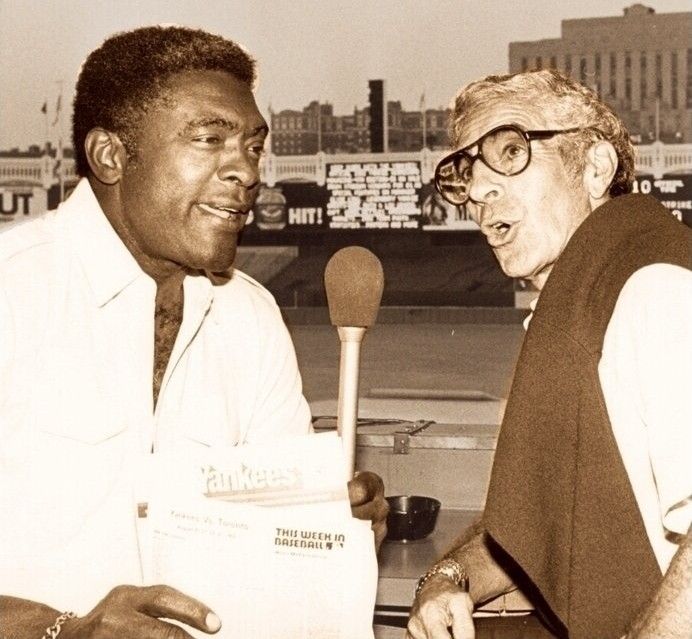
Ironically, as much as Bill White was a part of the Yankee decline, he became a big part of the Yankee revival when he joined the New York broadcast booth in 1971. He, along with his partners Frank Messer and Phil Rizzuto, gave Yankee listeners hours of enjoyment leading up to four World Series appearances for the revitalized Bronx Bombers.
Check out the link below for more about Bill White from an excellent posting by Ralph Wimbish of an article by Jon Rimmer in SB Nation’s Pinstripe Alley. The link includes Bill’s famous call of the dramatic Bucky Dent home run in the 1978 playoff game in Fenway Park which still gives me goose bumps.
The above stats are from Baseball Refence.com and the Baseball Almanac.
And check out my book Mickey Mantle’s Last Home Run.
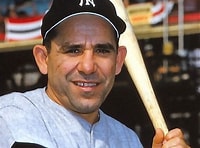
I was struck by an AP headline in October during last year’s World Series which went like this: “Mr. Clutch Riley Comes Up Big Again, Braves Win Game 3.” The article went on: “Austin Riley, the Braves third baseman, keeps coming up with one clutch hit after another on baseball’s biggest stage.” It then mentioned Riley’s walk-off hit in Game 1 of the NLCS against the Dodgers, and his go-ahead hit in Game 6 which helped propel the Braves to the World Championship. And Riley’s big hit in Game 3 of the World Series put Atlanta ahead. No doubt Austin Riley is an exciting young player, and he came through on baseball’s biggest stage, but for me, growing up in the fifties and sixties, there was only one Mr. Clutch and that was Yogi Berra of the New York Yankees.
I’m not sure when or how Yogi got that moniker, but a closer examination of Yogi’s career confirms that he earned it. What does it mean to be a clutch hitter? In simple terms it means coming through at the plate in an important time during a game and even more so in an important game. It answers the question “who do you want up?” when the game’s on the line. The answer to that question was always Yogi Berra. But how can you measure such a quality? Did Berra really deserve to be called Mr. Clutch?
After doing a deep dive in Baseball-Reference.com some remarkable statistics can be uncovered. Berra, a .285 lifetime hitter, actually batted even better, .292 in the 7th through 9th innings. And he batted an incredible .307 in late and close games (which is defined by the 7th inning or later when his team is tied, ahead by one, or the tying run is at least on deck) and with a .531 slugging percentage. So, there is no doubt that Yogi, throughout his career, was a clutch hitter.
But what about hitting in important games? Well in baseball there are no more important games than those of the World Series. And on that stage Yogi’s performance was truly exceptional. He appeared in 14 Fall Classics throughout his 19-year career batting .274, but if you focus in on Berra’s peak years from 1953 through 1957 when he was age 28-32 his performance was nothing short of amazing. In the four World Series in that time frame (Cleveland won the AL pennant in 1954) Berra’s batting average was a stunning .378 with a slugging percentage of.516, all while catching for some of baseball’s greatest World Series pitchers like Allie Reynolds, Vic Raschi, Whitey Ford, and of course, perfect-game hurler Don Larsen.
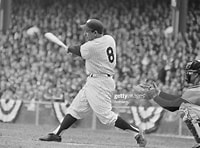
As for key hits in the Series, ol’ #8 had plenty.
1952 Game 6 versus Brooklyn. The Yanks were down 3-2 in the Series and behind 1-0 in the seventh when Berra blasted a home run to tie the game which New York would go on to win and then eventually beat the Dodgers in game 7 for the WS victory.
1956 versus Brooklyn. Everybody remembers Larsen’s Game 5 perfect game for which Berra called the signals, but Yogi also wielded a hot bat throughout that seven-game series blasting three home runs. He hit a grand slammer in game two and in the vitally important game seven, Berra hit two, two-run homers in his first two at bats to propel New York to an easy 9-0 victory.
And even when he made outs there was incredible drama. Berra was always described as a tough out. Afterall a clutch hitter by definition would be a tough out. An underappreciated aspect of Yogi’s game was the fact that he almost always put the ball in play. In other words, he was really tough to strike out. Berra was only rivaled by such great sluggers as Joe DiMaggio and Ted Williams for his ability to hit for power and still rarely strike out. Clutch hitters, at the very least put the ball in play, even if they make an out and ol’ # 8 made two of the most dramatic outs in World Series history.
1955 Game 7 versus Brooklyn. The Yankees were down 2-0 in the bottom of the sixth and having great difficulties against the Dodgers’ young phenom pitcher, Johnny Podres. With first and second and no one out the Yanks finally had a rally going. Yogi came up in the clutch situation and put the ball in play with a long, slicing flyball to the leftfield corner. A for-sure game-tying double. But Sandy Amoros, the Dodger leftfielder, made a spectacular one-handed running catch, then wheeled, fired in and doubled Gil McDougald off first. The rally was over, and the Dodgers went on to win the game 2-0 and their first World Series.
1960 Game 7 versus Pittsburgh. The top on the ninth, with NY down 9-8, one out and first and third, Yogi came to the plate with the game on the line and smashed a hot ground ball down the first baseline which was stabbed by Pirate first baseman Rocky Nelson who hand been holding the bag with Mickey Mantle on first. Nelson immediately stepped on the bag to put out Berra and needing one more out to win the Series he wheeled to throw to second to get Mantle. But in a brilliant base-running move Mantle swerved back to first avoiding Nelson’s tag. The run scored from third and the game was tied. A clutch out by Berra aided by some amazing clutch base running by Mantle. Unfortunately for the Yanks Mazeroski hit his famous home run in the bottom of the ninth.
Such was a recap of Yogi Berra’s clutch World Series performances.
But even if Yogi Berra was such a clutch hitter, what about all the other great hitters in baseball? Did they somehow fall short in dramatic situations despite their storied careers? Well as might be expected such is not the case. A closer look at Berra’s slugging contemporaries shows that they too performed well in the clutch. In late and close games Willie Mays, hit .306, Ted Williams hit .320 and Mickey Mantle hit .323. Berra’s .307 in late and close games does however surpass other Hall-of-Fame catchers like Roy Campanella .284, Johnny Bench .274 and Carlton Fisk .265.
So, however you want to slice it, Yogi Berra will always be Mr. Clutch to me and his immense legion of baseball fans.
References: Baseball-Reference.com, The Baseball Almanac.
By guest blogger, baseball historian and author Gary Livacari
There’s little debate that Ted Williams was one of, if not the greatest, pure hitter the game has ever seen. In his 19-year major league career (1939–1942, 1946–1960), “Teddy Ballgame” was a seventeen-time All-Star, two-time American League Most Valuable Player, six-time American League batting champion, four-time American League home run leader, four-time American League RBI leader, and two-time Triple Crown winner. That’s quite an impressive resume.
Over his career, Ted hit .344 (seventh all-time), with 2,654 hits, 521 home runs (19th all-time), 1839 RBIs (14th all-time), and a .482 on-base percentage (first all-time). His .634 slugging average is second behind only Babe Ruth’s .689. His 191 career OPS+ is also second, behind only Ruth’s 206 (100 being the major league average).
Let’s Speculate a Bit!
What if Ted Williams hadn’t lost approximately 4.75 years to military service? What would his career numbers look like? We can only take a reasonable guess.
He hit 521 home runs in his 19-year career. According to Baseball-Reference, his 162-game average computes to 37 home runs per year. Since at least two of those lost 4.75 years were subprime years, I’ll use a conservative estimate of an additional 32 per year. That extrapolates to an additional 152, for a career total of 673 home runs, good for sixth on the all-time list.
His speculated career RBI total is even more dramatic. His 162-game average for 19 seasons is 130. Dropping that figure down to a conservative 120 per year, that computes to an additional 570 RBIs, for a career total of 2409. That would just beat out Hank Aaron’s 2397 RBIs by 12 for first place on the all-time list.
Ted Williams was a first-ballot selection to the Hall of Fame in 1966 and his #9 has been retired by the Red Sox. He was named to the Major League All-Century team and the Major League Baseball All-Time team.
He was a great one for sure. I was fortunate enough to see him in person only once, at his last game in Chicago at Comiskey Park in September 1960. If you have any memories of Ted you’d like to share please do so in the comments section.
Check out Gary’s excellent website:
“Baseball History Comes Alive!” with over 1200 fully categorized baseball essays and photo galleries, now surpassing the 700K hits mark at 75K hits: www.baseballhistorycomesalive.com
Photo Credits: From Bing search.
Information: Excerpts edited from Ted Williams Wikipedia page; stats from Baseball-Reference







 Back Home With Baseball and Beyond