
This year marks the 25th anniversary of what could be regarded as the best baseball team of all time, the 1998 New York Yankees. In his new book The Inside Story of the Greatest Baseball Team Ever The 1998 Yankees author Jack Curry makes a convincing case. If you are a baseball fan and you haven’t read Curry’s book you should. If you are a Yankee fan you must.
As a long time Yankee fan, I didn’t need much convincing, though I had to do some research on the 1961 Yankees, the team I grew up watching, to make sure Curry’s argument held up. And it does. It also holds up against all the other great teams in baseball history. By all means get Curry’s informative and enjoyable book to see his complete argument. For my blog here I will focus in on what I believe are the most important facets support the conclusion that the 1998 New York Yankees are the best team ever.
First, to set some parameters: I am not talking about the best collection of players, nor am I measuring the team over a course of several seasons. I am not talking about a dynasty team (though the 1998 Yankees were part of a dynasty team that won four World Championships and five AL Pennants over the course of 6 years; 1996-2001). I’m talking about a team having the greatest single season ever. And for this I believe there is no doubt.
The two most important categories to consider are wins, of course, and winning the World Series. A lesser category would be winning percentage.
Let’s start with winning percentage as the fairest way to differentiate a really good team from a great team. Afterall, winning percentage accurately accounts for the significance of the different lengths of seasons from baseball’s different eras. Specifically, the change from 154 games to 162 games which occurred in 1961. Using .700 as the dividing line we find nine teams in modern baseball history (since the beginning of the World Series in 1903) that had a regular season winning percentage over .700.
Here is the list:
1906 Chicago Cubs .763 W 116 L 36
1909 Pittsburgh Pirates .724 110-42
1954 Cleveland Indians .721 111-43
2001 Seattle Mariners .716 116-46
1927 NY Yankees .714 110-44
1998 NY Yankees .704 114-48
1931 Philadelphia Athletics .704 107-45
1907 Chicago Cubs .704 107-45
1939 NY Yankees .702 106-45
Of these nine teams four can be eliminated because despite their fantastic regular season they failed to win the World Series. In my book you can’t be considered the best team ever if you couldn’t even win the championship. So, despite having the most regular season wins at 116 both the 1906 Cubs and the 2001 Mariners are both eliminated because they failed to win the World Series. The Cubs lost to their crosstown rivals the White Sox and the Mariners failed to even make it to the World Series, losing in the playoffs to the Yankees. The 1954 Indians and the 1931 Athletics also failed to win the World Series so that leaves us with five teams remaining.

This is a tough call, but I’m going to eliminate the 1909 Honus Wagner led Pittsburgh Pirates because they had a difficult time in the World Series needing seven games to beat Ty Cobb’s Detroit Tigers. The remaining four teams all went undefeated in the World Series although the 1907 Cubs took five games to defeat the Tigers with one game ending in a tie.
To differentiate the four remaining teams, I will use a rough metric from the Baseball Almanac where the teams’ yearly stats are compiled showing the leaders in ten offensive categories such as batting average and runs and eight pitching categories such as ERA and strikeouts. The best team here is the 1927 Yankees who led in 12 categories, the 1939 Yankees 10 categories, the 1998 Yankees eight categories, and the 1907 Cubs only five categories. Using this metric, I will give the 1907 Cubs with the lowest score the boot leaving the three Yankee teams as the finalists. I know, I’m a Yankee fan, but what can I say, the stats don’t lie.
The Baseball Almanac’s metric has however a significant flaw. It can’t account for a major difference between the two eras; before and after the leagues expanded. The 1998 Yankees competed against twice as many teams as the 1927 and 1939 Yankees, thus it was much more difficult to lead in a category. But we can use that metric to compare the 1927 Yanks and the 1939 Yanks, and we can give Babe Ruth’s Yanks the nod over Joe DiMaggio’s lower scoring Yanks, thus eliminating the 1939 Yanks and leaving just the 1998 Yankees and the 1927 Yankees in the competition.

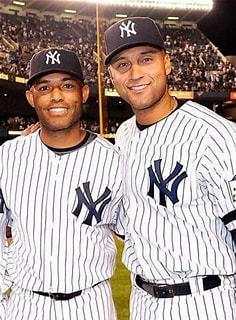
So, comparing two teams from two different eras can be difficult but it also can be fun. I know growing up and watching the 1961 Yankees every day; as the season went on there were discussions as to whether the 1961 Yankees with the M&M Boys, Mantle and Maris, could compare with Ruth and Lou Gehrig and the Murders Row of 1927. At that time the 1927 Yankees were considered the best team of all-time, at least in my neck of the woods and without any advanced metrics. The ’27 Yankees certainly had all the power and glitz with two of the all-time greats in their lineup, Ruth, and Gehrig. The ’98 Yankees didn’t lack in star power with two emerging Hall of Famers, Derek Jeter, and Mariano Rivera on their roster. They also had the AL batting champ Bernie Williams and a solid pitching staff with borderline Hall of Famer David Cone, plus Andy Pettitte and David Wells. As a result, I must contend that it all comes down to wins. The 1998 Yankees, winning 114 regular season games and 11 post season games for a total of 125 wins, had more wins than any other team ever, and 11 more than the 1927 Yankees. Now you could argue that if the 1927 Yankees played 23 more games, they probably could have won at least 12 of them. The problem is, that would be mere speculation and there is no way to know, and we will never know. There is no other way around it, the 1998 New York Yankees, winner of 125 games, are simply the best.
A couple of footnotes.
One reason the 1998 New York Yankees do not get the credit they deserve is that the year 1998 in baseball is primarily remembered for the incredible home run competition between Mark McGwire and Sammy Sosa. As the Yankees dominated the American League with record setting precision, McGwire and Sosa were captivating the entire nation with their quest to break Roger Maris’s single-season home run record. Prior to any suspicions of PED’s they were America’s sports heroes as McGwire blew by Ruth and Maris with 70 home runs and Sosa doing the same with 66.
Curry’s book also mentions a comparison of the greatest teams done by the website FiveThirtyEight using a complex set of metrics. FiveThirtyEight lists the 1939 Yankees as number one, kudos to Joe D, but the ’39 Yanks had the lowest winning percentage of our nine .700 teams, and it somehow rates the 1906 Cubs number two despite losing the World Series. For those reasons I believe their metrics are flawed. They even dropped our 1998 Yankees to fifth, behind the ‘27 Yankees and the ’09 Pirates which I certainly find unjustifiable.
References:
The Inside Story of the Greatest Baseball Team Ever The 1998 Yankees by Jack Curry
Baseball Almanac
 Back Home With Baseball and Beyond