
By guest blogger Bruce Solomon
Few realized that baseball history would be made on July 16, 1866, a sweltering,
humid afternoon, when the Philadelphia Athletics took the field against the Alerts of
Danville at their new ball grounds in the City of Brotherly Love. Just a year earlier, the
field served as a bivouac and staging area for the Union Army in the waning days of
the Civil War. Up to the plate stepped 21-year-old Brooklyn native Lipman Pike, the
son of Jewish refugees from Holland and the fastest, strongest player on the Athletics
squad. Pike clouted the first pitch he saw deep to the gap in center field, using his
tremendous speed for an inside-the-park home run. In each of his next four at-bats,
Lip deposited the ball over the right field fence onto Columbia Avenue. Standing only
5’ 8” and 158 pounds, Lipman Pike was a veritable David amongst Goliaths, hitting five
home runs in five consecutive at-bats in one game – a feat that hasn’t been matched in
158 years.

A local newspaper published that Pike, and two other players were paid $20 per week
under the table by the Athletics, violating the amateur status of the “gentlemen’s sport”.
Pike was ordered to appear before the governing committee of the National
Association of Base Ball Players. The matter was dropped when no one from the
Association bothered to show up for the hearing. As a result, Lipman Pike is
considered one of the first professional athletes in America.
Lipman Pike went on to a storied career as professional baseball’s first slugger, first
Jewish player and manager, and the first American Jew to gain national fame as a
sports icon. Tales of his feats became the stuff of legend. 1871 was the first year of
the first professional baseball league, the National Association. Lipman Pike signed to
play with the Troy Haymakers, who named him their captain and field manager – the
first and only Jewish manager in baseball for the next 71 years. Pike led the National
Association in home runs in 1871, 1872 and 1873, hitting 17.2 percent of the home
runs swatted in the league in 1872, a record not broken until Babe Ruth in 1920. He
holds the all-time career records for home runs and extra base hits in the National
Association and won the home run crown in the National League in 1877, its second
year of existence.

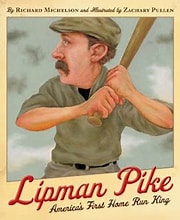
Pike was one of the fastest men in baseball. He would race any challenger for a cash prize and a side bet. In 1873, Pike raced against a trotting horse named Clarence in a 100-yard sprint at Baltimore’s Newington Park and won by 4 yards in a time of 10 seconds flat, earning $250 (worth about $6100 today).
While playing a game at Lakefront Park in Chicago in 1878, Lip Pike hit the longest double in major league history. Pike’s blast not only cleared the fence, but also a freight shed and half a dozen railroad cars, landing in a freight car traveling east. The
Cincinnati Enquirer estimated the ball flew 600 feet, but legend has it that it traveled
another 482 miles by rail. Due to the ground rules at Lakefront Park, Pike was only
credited with a double. A few years later in Albany, Pike hit a ball over the wall at
Riverside Park into the river. Right fielder Lou Knight began to go after the ball in a
boat, but finally gave up. This time, in spite of the ground rule, Pike was credited with
a home run.
His baseball career over, Lipman Pike became a successful haberdasher in Brooklyn,
where he was beloved and celebrated by the Jewish community. Lip’s haberdashery
became a successful business and a meeting place for the local baseball cognoscenti.
There was an outpouring of grief after his death from heart disease in 1893 at the age
of 48. The Sporting News wrote: “Pike . . . was one of the few sons of Israel who ever
drifted to the business of ball playing. Called out by Umpire Death . . . Lip Pike was
one of the greatest sluggers who ever batted.”

In the inaugural election for the Baseball Hall of Fame in 1936, Lipman Pike received
one vote. He may not have a plaque in Cooperstown, but never fear. Lipman Pike,
this pioneer who held many of early baseball’s firsts, who as a young man lived up to
the nickname bestowed upon him, “The Iron Batter”, became professional baseball’s
first legitimate slugger. He was a 19th century ballplayer whose prowess on the ballfields
reflected the pride and hope felt by America’s most recent immigrant influx, Jewish
people. In 1985, one hundred nineteen years after he hit 5 home runs in 5 consecutive
at-bats in a game; ninety-two years after he succumbed to heart failure, Lipman Pike
was decisively elected to a place of honor on the bimah of the Jewish Sports Hall of
Fame in Netanya, Israel. You know how to get to the Jewish Sports Hall of Fame?
Start out in Cooperstown and when you can’t find a Lipman Pike plaque, take a hard
right and travel 6,000 miles straight to Netanya.
 Back Home With Baseball and Beyond