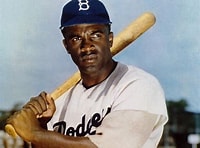
Billy Tried it Too

While researching my last post about Jackie Robinson’s iconic steal-of-home in game one of the 1955 World Series I made a remarkable discovery. I was studying the box score of that game reprinted on BaseballAlmanac.com and was dumfounded when I read the following baserunning notes:

SB-Robinson (1, Home off Ford/Berra). CS Martin (2, 2nd base by Newcombe/Campanella, Home by Bessent/Campanella).

Say what? Billy Martin was caught stealing home in the same game as Jackie Robinson’s iconic steal??

“Tis the truth!” Nobody ever talks about it, but Billy Martin tried to steal home in the same game as Robinson’s famous steal. And two innings earlier.
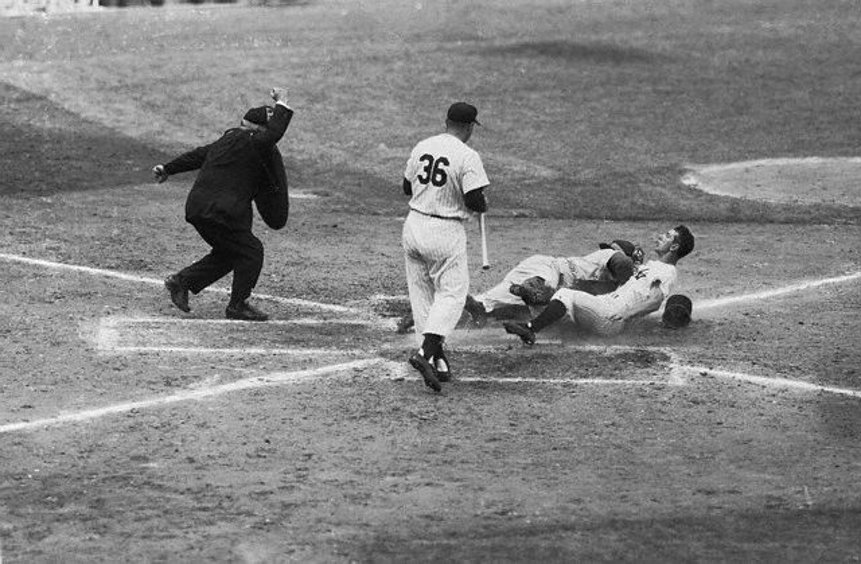
Billy Martin out stealing home in the sixth inning game one of the 1955 World Series

According to an article in SABR Martin tripled to deep left off Don Newcombe with two outs in the bottom of the sixth. Martin had already been caught stealing second earlier in the game. Joe Collins had hit a two-run homer in the inning and the Yankees had a comfortable 6-3 lead, so it was not a bad strategy to try to steal an insurance run with the bottom of the order coming up. Don Bessent had just replaced Newcombe on the mound when Martin took off for home and was tagged out by Dodger catcher Roy Campanella. The fiery pepper-pot Martin took exception to the high tag and took a few steps toward Campanella but decided instead to retreat to the Yankee dugout. He later said that he thought he was tagged in the throat. After the game Campanella spoke to the press. “Tell that little so-and-so that I missed. I tried to put the ball in his mouth.” Undoubtedly Campy knew that Billy had labeled him “spike shy” before the World Series started and so there was some bad blood between them.

It’s also quite possible that Robinson’s steal-of-home was instigated by Martin’s brazen attempt. Martin’s exceptional World Series play* had been a thorn in the Dodgers’ side for years and perhaps Robinson had had enough of Martin and needed to finally show up Bad Billy on the big stage.

Here’s a bit more psychoanalytic baseball. Remember how Yogi Berra reacted to Robinson’s steal. He basically went ballistic. Well in another World Series game one, this time in 1951 against the New York Giants, Monte Irvin, the Giant’s dynamic young outfielder slid safely past Yogi’s tag for a steal-of-home. When Robinson accomplished his feat four years later ol’ Yogi must have been thinking “not again” and went crazy.
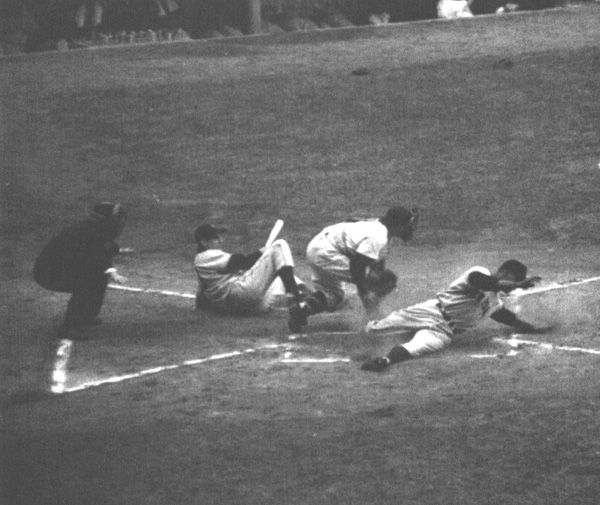
Monte Irvin steals home in game one of the 1951 World Series

So how rare is a straight steal-of-home in the World Series? In the 119 World Series going back to 1903 there have been only 13 attempted steals-of-home and only five were successful. The last attempt occurred in 2020 when Manuel Margot of Tampa Bay was nailed in game five against the LA dodgers.
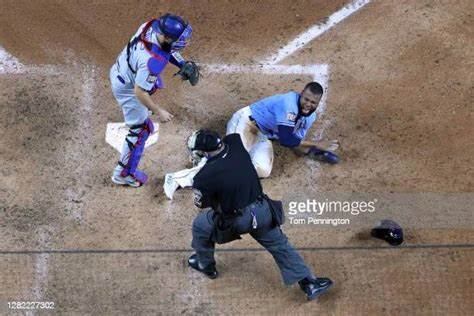
Manuel Margot out stealing home in game five of the 2020 World Series

Lonnie Smith of the Cardinals was out stealing home in game 6 of the 1982 World Series against the Brewers.

In 1955 game one Robinson was safe, and Martin was out.

Monte Irvin was safe in game one 1951.

We then have to go back 30 years for the next attempt and there were two 1921. Bob Meusel stole home for the Yankees in game two (Babe Ruth also stole two bases in that game, but not home). Mike McNally stole home for the Yankees in game one.

There were six attempts in the dead ball era and only Ty Cobb was successful when he stole home in game two of the 1909 World Series. He was out stealing home in 1908. Cobb was credited with a remarkable 32 steals-of-home in his career.

Fred Snodgrass was called out in 1911. Johnny Evers was out twice, 1907 and 1909 and Tommy Leach was nailed twice, in 1903 and 1909.

So back to Yogi’s lament as he commented on Robinson’s steal of home calling it a bad play. He may have been correct in theory. Of the 13 attempted steals-of-home in the World Series only five were successful. A .384 percentage. Good for a batting average not so good for baserunning when you consider the many other ways to score from third base even with two outs—any kind of base hit, a wild pitch, a passed ball, an error, a balk. And only once did the team with the successful steal home go on to win the World Series. That of course was the Dodgers’ by Jackie Robinson which we are still arguing about, but which may never have happened if not for Billy Martin’s brash attempt that nobody remembers.     

References: Baseballalmanac.com; SABR; Matt Kelly for MLB

*Check out my Billy Martin post from 2022.
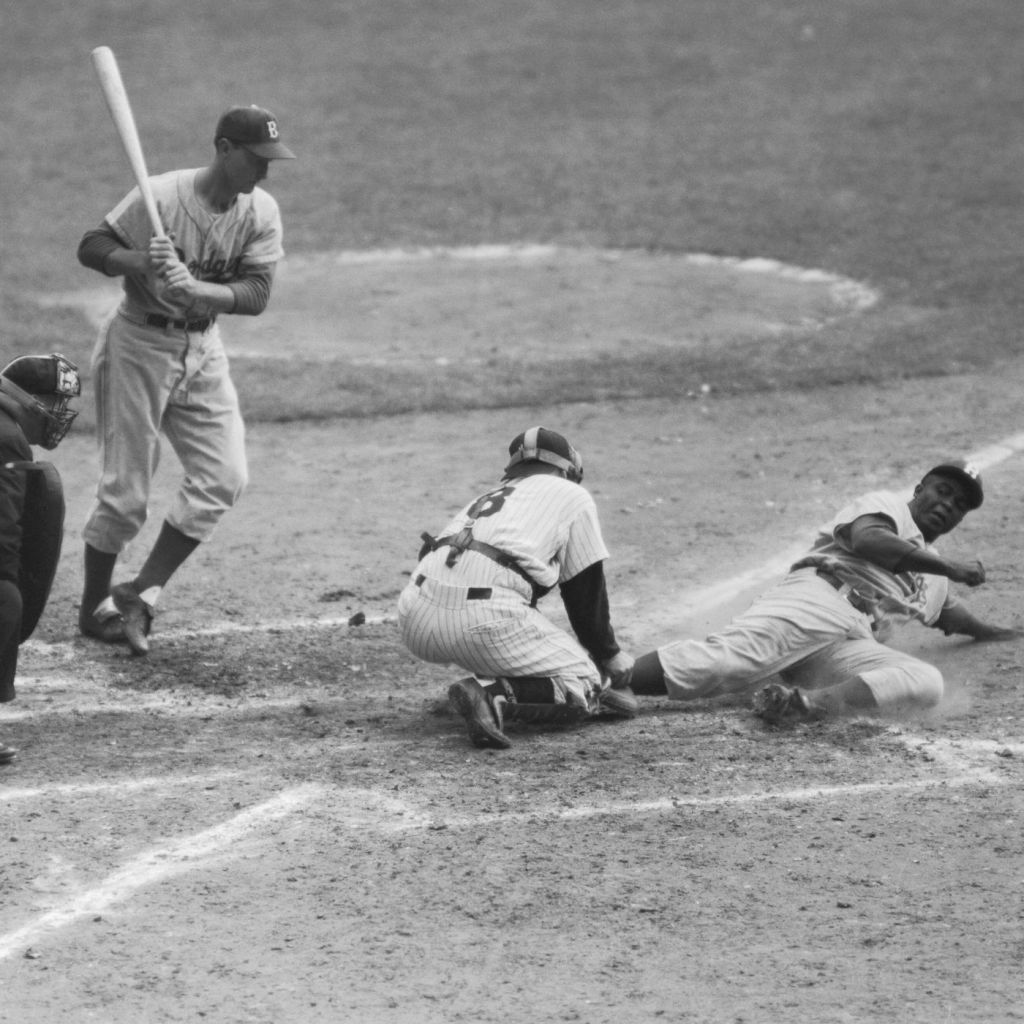
The Steal of the Century

It was 69 years ago today that Jackie Robinson stole home for the Brooklyn Dodgers against the New York Yankees in game one of the 1955 World Series. It is a play that is this talked about and argued about to this day. And it is one of the moments in baseball history that explains Why We Love Baseball as told by Joe Posnanski in his great book of the same name. I’ll set the stage here and then let Posnanski take over with an excerpt from his fabulous book. Most baseball fans are familiar with the accounts of the event but read to the end to see and feel the true poignancy of the moment.

Jackie Robinson was on third base in the eighth inning of game one. There was one out and the Dodgers were down by two runs. The Dodgers had never beaten the Yankees in a World Series having lost 5 previous times. Whitey Ford was on the mound for New York and of course Yogi Berra was behind the plate. Robinson took off for home and as he slid into home Berra applied the tag. Umpire Bill Summers called Robinson safe. Berra did not agree. There is a huge picture of this moment in the Yogi Berra Museum in Montclair, New Jersey. According to Posnanski and Yogi’s family whenever Berra passes the photo, no matter what he is talking about, he points to the photo and declares “safe”.

According to Posnanski there are three reasons why people still talk about this play. First, it involved two of the games’ most iconic players, Robinson and Berra. Second, it involved one of baseball’s greatest rivalries, the Dodgers and the Yankees. Third, we still don’t know whether Robinson was safe or out.

I’ll let Posnanski take over from here.

               Oh, you might think you know whether Robinson was safe or out. Lots of people think they know. Robinson was on third, a nice-sized lead and he was watching Ford closely. He then took small hops and took off for the plate while Ford was in his windup. Ford’s pitch beat him there, Yogi caught it with his left foot on home plate, he reached down with both his glove and right hand and tried to tag Robinson’s right foot just before it touched home.

               Out? Safe? Home plate umpire Bill Summers did not hesitate. He ruled safe. Berra was sure he’d blown the call, so sure that he stood up and tore off his mask and began screaming at Summers like he never had at an umpire and never would again. Summers just kept stretching his arms, again and again, a repeat of his safe call, and then turned his back on Berra.

               People have been arguing ever since.

There is one surviving film of the play. The replay shows everything… and nothing at all. It is a Rorschach replay. You will see in it exactly what you want. If you want to see Robinson out, he’s out. If you want to see him safe, he’s safe.

“It was bush stuff,” Berra shouted to reporters after the game. “It was showboat strategy, stealing home when you’re two runs behind like that. It was a bad play.”

               Reporters raced over to Robinson for a response.

               “The only thing bush about it,” Robinson replied, “was Berra’s tag.

               Reporters raced back to Berra for his response to the response.

               “He was out,” Berra said. “The call was blown. It was the wrong play, and he was out.”

               Back to Robinson.

               “Tell him to worry about himself,” Robinson said. “He didn’t tag me until after I crossed.”

               Back and forth. The Yankees, as you know, won the game. But the Dodgers ended up winning that World Series—they finally beat the Yankees—and Jackie Robinson’s stolen base became a symbol of that victory.

And here’s the best part of the story. I’ll let Posnanski continue.

Jackie Robinson died in 1972. And for the next 40-plus years, Yogi Berra would often find himself at a banquet or celebration or gathering with Jackie’s widow Rachel Robinson.

               They always greeted each other the same way.

               “Safe,” Rachel would say.

               “Out,” Yogi would say.               

And then the two would laugh and hug.

References: Why We Love Baseball A History in 50 Moments by Joe Posnanski

The Baseball Almanac

Yogi Berra Museum & Learning Center 8 Yogi Berra Drive Little Falls, NJ

Jackie Robinson’s First Game in Organized Baseball-Jersey City, April 18, 1946

By guest blogger Bruce Solomon

Jackie Robinson and George “Shotgun” Shuba

Jackie Robinson made his professional debut not in Brooklyn in 1947, but 76 years ago today in Jersey City, when the Dodgers’ Triple A team, the Montreal Royals opened their minor league season in Roosevelt Stadium, the home park of the Jersey City Giants. 

Mayor Hague declared Opening Day in Jersey City a holiday for city employees and school children.  On April 18, 1946, Jackie Robinson, wearing a Montreal Royals jersey (#9) stepped to the plate in front of 51,837 raucous fans at the over-capacity Roosevelt Stadium in Jersey City.  Jackie Robinson settled in for his first official at-bat as a professional in an integrated baseball game.  Nervous?  Perhaps, but not for long.  On a full count pitch in his first at-bat, Robinson grounded out to the shortstop. It was the only out he’d make that day. His next plate appearance was a three-run homer, and he was met at home plate with an outstretched hand by teammate George “Shotgun” Shuba – fixed in time by the famed photograph of the moment when black and white teammates saluted each other on the diamond. Robinson followed up the dinger with a bunt single, a steal of second, and ultimately a balk home after rattling the pitcher dancing down the third base line. Robinson’s final stat line was 4-5 with four RBIs in a 14-1 victory.

Click the link below for more about George Shuba.

https://www.latimes.com/local/obituaries/la-me-george-shuba-20141001-story.html

Changing History #42

By guest blogger Jeff Robinson

with contributions by Gary Armbruster

The Mets had a wonderful opening day ceremony today honoring Jackie Robinson who made his debut with the Brooklyn Dodgers 75 years ago. It reminds me of the great song by Garland Jeffreys, “Color Line” which was very appropriate for today’s celebration in Queens. The song is from Jeffreys’ 1991 album, Don’t Call Me Buckwheat. Check out the YouTube link below. It shows the album cover which has Jeffreys as a young kid in front of what appears to be Ebbets Field. Garland Jeffreys is now retired. I last saw him in a sold-out concert about seven years ago at Rahway’s Hamilton Stage and he was still rockin’ and rollin’.

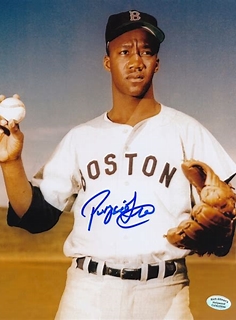
The Dodgers were the first major league team to sign a black player. The Boston Red Sox were the last. Elijah “Pumpsie” Green made his debut with Boston on July 1, 1959. He was the brother of Cornell Green who starred with the Dallas Cowboys playing 13 years as a defensive back and appearing in two Super Bowls.

Jackie Robinson had a Hall of Fame career with a lifetime batting average of .313. He was a seven-time All Star, Rookie of the Year in 1947, and the National League MVP and NL Batting Title winner in 1949. He appeared in six World Series with the Dodgers including their World Championship in 1955. Pumpsie Green played four years with the Boston and finished his career in 1963 with the New York Mets.

References from: Baseball-reference.com

Changing History

Today marks the 75th anniversary of Jackie Robinson’s first game in Major League Baseball. Robinson’s appearance that day in a Brooklyn Dodgers’ uniform, wearing his iconic number 42, allowed Major League Baseball to begin the process of overcoming its devastating and immoral white man problem. And because of Robinson’s remarkable grit and grace Major League Baseball would free itself from the bondage of its “white men only” policy and begin to welcome in some of the greatest American athletes. Such brilliant players as Larry Doby, Willie Mays, Hank Aaron and Roberto Clemente would soon don major league uniforms and enable baseball to truly become America’s pastime.