The Steal of the Century

It was 69 years ago today that Jackie Robinson stole home for the Brooklyn Dodgers against the New York Yankees in game one of the 1955 World Series. It is a play that is this talked about and argued about to this day. And it is one of the moments in baseball history that explains Why We Love Baseball as told by Joe Posnanski in his great book of the same name. I’ll set the stage here and then let Posnanski take over with an excerpt from his fabulous book. Most baseball fans are familiar with the accounts of the event but read to the end to see and feel the true poignancy of the moment.

Jackie Robinson was on third base in the eighth inning of game one. There was one out and the Dodgers were down by two runs. The Dodgers had never beaten the Yankees in a World Series having lost 5 previous times. Whitey Ford was on the mound for New York and of course Yogi Berra was behind the plate. Robinson took off for home and as he slid into home Berra applied the tag. Umpire Bill Summers called Robinson safe. Berra did not agree. There is a huge picture of this moment in the Yogi Berra Museum in Montclair, New Jersey. According to Posnanski and Yogi’s family whenever Berra passes the photo, no matter what he is talking about, he points to the photo and declares “safe”.
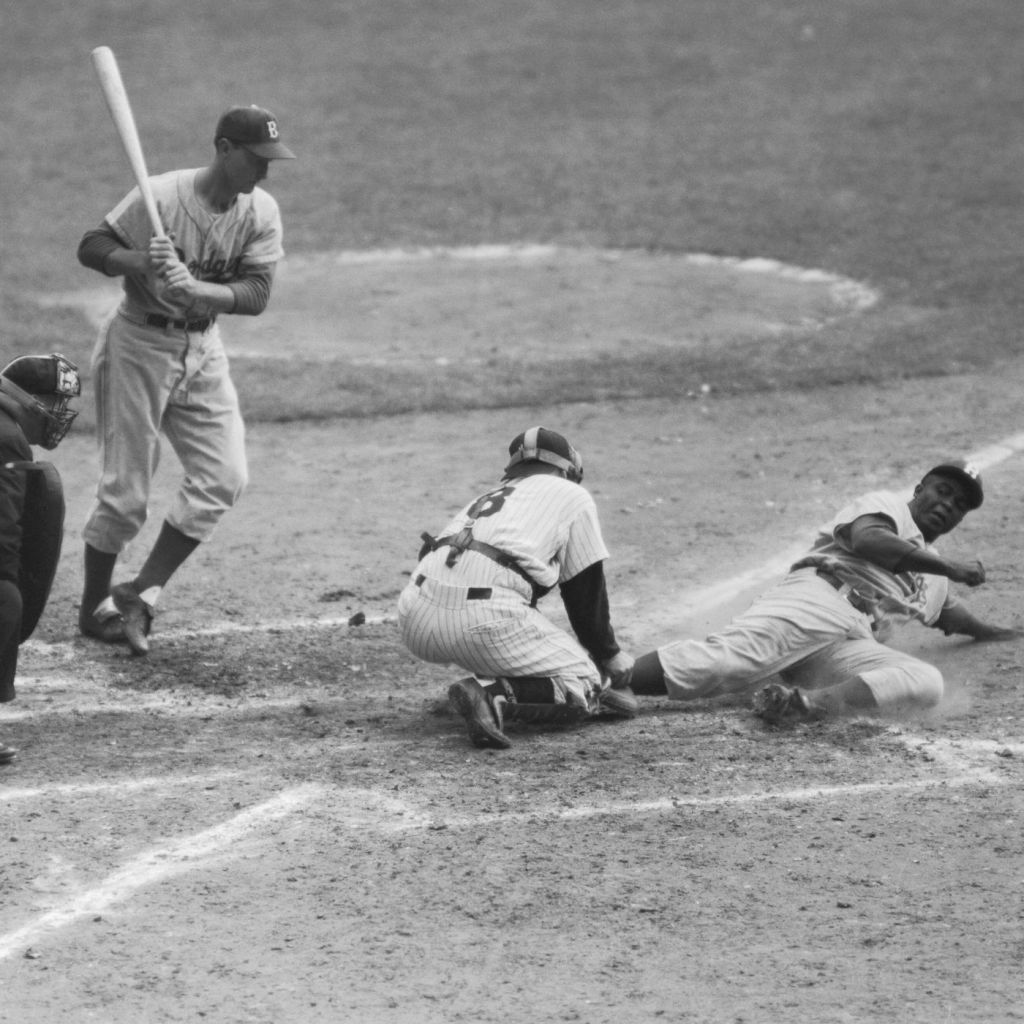
According to Posnanski there are three reasons why people still talk about this play. First, it involved two of the games’ most iconic players, Robinson and Berra. Second, it involved one of baseball’s greatest rivalries, the Dodgers and the Yankees. Third, we still don’t know whether Robinson was safe or out.

I’ll let Posnanski take over from here.

               Oh, you might think you know whether Robinson was safe or out. Lots of people think they know. Robinson was on third, a nice-sized lead and he was watching Ford closely. He then took small hops and took off for the plate while Ford was in his windup. Ford’s pitch beat him there, Yogi caught it with his left foot on home plate, he reached down with both his glove and right hand and tried to tag Robinson’s right foot just before it touched home.

               Out? Safe? Home plate umpire Bill Summers did not hesitate. He ruled safe. Berra was sure he’d blown the call, so sure that he stood up and tore off his mask and began screaming at Summers like he never had at an umpire and never would again. Summers just kept stretching his arms, again and again, a repeat of his safe call, and then turned his back on Berra.

               People have been arguing ever since.

There is one surviving film of the play. The replay shows everything… and nothing at all. It is a Rorschach replay. You will see in it exactly what you want. If you want to see Robinson out, he’s out. If you want to see him safe, he’s safe.

“It was bush stuff,” Berra shouted to reporters after the game. “It was showboat strategy, stealing home when you’re two runs behind like that. It was a bad play.”

               Reporters raced over to Robinson for a response.

               “The only thing bush about it,” Robinson replied, “was Berra’s tag.

               Reporters raced back to Berra for his response to the response.

               “He was out,” Berra said. “The call was blown. It was the wrong play, and he was out.”

               Back to Robinson.

               “Tell him to worry about himself,” Robinson said. “He didn’t tag me until after I crossed.”

               Back and forth. The Yankees, as you know, won the game. But the Dodgers ended up winning that World Series—they finally beat the Yankees—and Jackie Robinson’s stolen base became a symbol of that victory.

And here’s the best part of the story. I’ll let Posnanski continue.

Jackie Robinson died in 1972. And for the next 40-plus years, Yogi Berra would often find himself at a banquet or celebration or gathering with Jackie’s widow Rachel Robinson.

               They always greeted each other the same way.

               “Safe,” Rachel would say.

               “Out,” Yogi would say.               

And then the two would laugh and hug.

References: Why We Love Baseball A History in 50 Moments by Joe Posnanski

The Baseball Almanac

Yogi Berra Museum & Learning Center 8 Yogi Berra Drive Little Falls, NJ

Lou Gehrig Day Yankee Stadium, July 4, 1939

As we celebrate our nation’s Independence Day those of us who are endeared to baseball, our national pastime, also know that this date has another profound significance. It was 85 years ago this day that Lou Gehrig, the Hall-of -Fame first baseman, gave his farewell speech at Yankee Stadium sadly ending his stellar 17-year career. It is beyond my ability to describe the poignancy of Gehrig’s words so I will leave that to one of my favorite poets, Ed Romond and his wonderful poem:

Lou Gehrig Day Yankee Stadium, July 4, 1939

He was scared and did not want to speak to 62,000 people.

Maybe he felt facing death was enough to endure but

they kept calling his name till he stepped up to the mic

and gave 278 words of thank you and goodbye. His body trembled

as he spoke with the voice of a dying man still strong enough

to unlock his heart before thousands and let them all come in.

The poem was dedicated to BJ Ward. You can find this poem and many other excellent poems in:

Home Team Poems About Baseball

By Edwin Romond

Published by Grayson Books


Remembering Yankee Glamour Boy Joe Pepitone

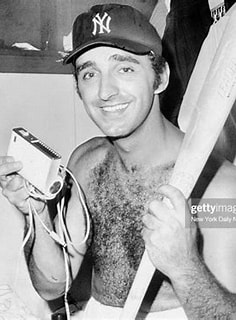
Former Yankee star Joe Pepitone passed away Monday at the age of 82. Born in Brooklyn, Pepi, as he was known, brought style and pizzazz to the staid New York Yankees when he arrived on the scene as a brash rookie in 1962. He was known as much for his waves of dark hair as he was for his power hitting and slick fielding. He shocked the major leagues by bringing a hairdryer into the locker room and though the world may have been on the edge of nuclear war, Pepi stole the headlines with his blow-dried locks.

Pepitone’s emergence allowed the Yankees to trade away their solid first baseman Bill Skowron at the end of the ’62 season for Dodger pitcher Stan Williams. Pepi then took over first base and had several fine seasons for the Bombers. He was a three-time All-Star and helped lead New York to two American League Pennants in 1963 and 1964. He averaged 23 home runs a season over his seven years as a starter for New York and earned three Gold Gloves for his exceptional play at first base. Remarkably, it was Pepi who took over in centerfield when the hobbling Mickey Mantle moved to first base in 1967.

My most searing memory of Pepitone came in the 1963 World Series. It was game four and the Yanks were up against the wall, down three games to zero to the LA Dodgers. The Dodgers had extraordinary pitching that year led by the unhittable duo of Sandy Koufax and Don Drysdale. Koufax was pitching another masterpiece in game four, matched by a superlative pitching performance by Whitey Ford. Trailing 1-0 in the top of the seventh, Mantle gave New York hope with a game-tying home run. But in the bottom of the seventh disaster struck for the Yanks. Jim Gilliam hit a routine ground ball to Clete Boyer at third, but Pepitone at first base astonishingly failed to catch the cross-diamond throw from Boyer. The throw hit the heel of Pepitone’s glove and bounded far enough away to allow Gilliam to go all the way to third. Tommy Davis then knocked in Gilliam with a sacrifice fly and Koufax sealed the 2-1 victory for the Dodgers with two scoreless innings in the eighth and ninth. Pepi later explained that he momentarily lost Boyer’s throw in the light-colored shirts of the sundrenched fans behind third base. It was a crushing way to end the series even though New York was thoroughly over-matched by the LA pitching.

Pepitone somewhat redeemed himself in the 1964 World Series with a big grand slam home run against the Cardinals leading New York to a win in game six. Ultimately Pepi’s time ended in disappointment with the Yankees. Known as the “Prince of Potential” or “a poor man’s Joe Namath” the glamour boy never reached the heights of stardom hoped for by Yankee fans. After their AL pennant in 1964 the fortunes for the Yankees faded as did those of the flashy young phenom named Joe Pepitone.

Pepi finished his career playing with modest success for the Chicago Cubs. After he retired in 1973, he became a fixture at Yankee Old-Timers’ games and his warm personality and delightful sense of humor continued to charm Yankee fans. He will surely be missed.

RIP # 25

References:

Baseball Almanac, Baseball-reference.com, Alan Zevin/NYTimes