The Steal of the Century

It was 69 years ago today that Jackie Robinson stole home for the Brooklyn Dodgers against the New York Yankees in game one of the 1955 World Series. It is a play that is this talked about and argued about to this day. And it is one of the moments in baseball history that explains Why We Love Baseball as told by Joe Posnanski in his great book of the same name. I’ll set the stage here and then let Posnanski take over with an excerpt from his fabulous book. Most baseball fans are familiar with the accounts of the event but read to the end to see and feel the true poignancy of the moment.

Jackie Robinson was on third base in the eighth inning of game one. There was one out and the Dodgers were down by two runs. The Dodgers had never beaten the Yankees in a World Series having lost 5 previous times. Whitey Ford was on the mound for New York and of course Yogi Berra was behind the plate. Robinson took off for home and as he slid into home Berra applied the tag. Umpire Bill Summers called Robinson safe. Berra did not agree. There is a huge picture of this moment in the Yogi Berra Museum in Montclair, New Jersey. According to Posnanski and Yogi’s family whenever Berra passes the photo, no matter what he is talking about, he points to the photo and declares “safe”.
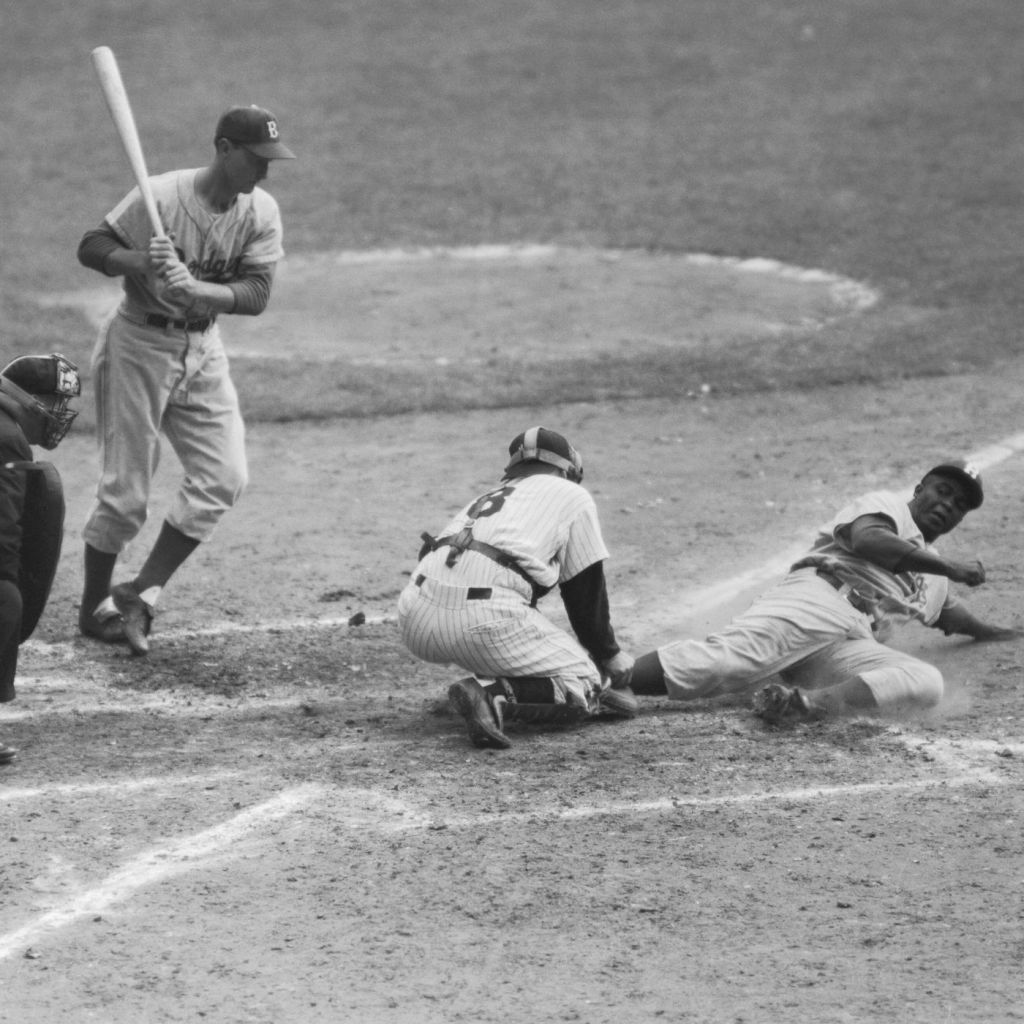
According to Posnanski there are three reasons why people still talk about this play. First, it involved two of the games’ most iconic players, Robinson and Berra. Second, it involved one of baseball’s greatest rivalries, the Dodgers and the Yankees. Third, we still don’t know whether Robinson was safe or out.

I’ll let Posnanski take over from here.

               Oh, you might think you know whether Robinson was safe or out. Lots of people think they know. Robinson was on third, a nice-sized lead and he was watching Ford closely. He then took small hops and took off for the plate while Ford was in his windup. Ford’s pitch beat him there, Yogi caught it with his left foot on home plate, he reached down with both his glove and right hand and tried to tag Robinson’s right foot just before it touched home.

               Out? Safe? Home plate umpire Bill Summers did not hesitate. He ruled safe. Berra was sure he’d blown the call, so sure that he stood up and tore off his mask and began screaming at Summers like he never had at an umpire and never would again. Summers just kept stretching his arms, again and again, a repeat of his safe call, and then turned his back on Berra.

               People have been arguing ever since.

There is one surviving film of the play. The replay shows everything… and nothing at all. It is a Rorschach replay. You will see in it exactly what you want. If you want to see Robinson out, he’s out. If you want to see him safe, he’s safe.

“It was bush stuff,” Berra shouted to reporters after the game. “It was showboat strategy, stealing home when you’re two runs behind like that. It was a bad play.”

               Reporters raced over to Robinson for a response.

               “The only thing bush about it,” Robinson replied, “was Berra’s tag.

               Reporters raced back to Berra for his response to the response.

               “He was out,” Berra said. “The call was blown. It was the wrong play, and he was out.”

               Back to Robinson.

               “Tell him to worry about himself,” Robinson said. “He didn’t tag me until after I crossed.”

               Back and forth. The Yankees, as you know, won the game. But the Dodgers ended up winning that World Series—they finally beat the Yankees—and Jackie Robinson’s stolen base became a symbol of that victory.

And here’s the best part of the story. I’ll let Posnanski continue.

Jackie Robinson died in 1972. And for the next 40-plus years, Yogi Berra would often find himself at a banquet or celebration or gathering with Jackie’s widow Rachel Robinson.

               They always greeted each other the same way.

               “Safe,” Rachel would say.

               “Out,” Yogi would say.               

And then the two would laugh and hug.

References: Why We Love Baseball A History in 50 Moments by Joe Posnanski

The Baseball Almanac

Yogi Berra Museum & Learning Center 8 Yogi Berra Drive Little Falls, NJ
Yogi Berra: Baseball’s Original Mr. Clutch

I was struck by an AP headline in October during last year’s World Series which went like this: “Mr. Clutch Riley Comes Up Big Again, Braves Win Game 3.” The article went on: “Austin Riley, the Braves third baseman, keeps coming up with one clutch hit after another on baseball’s biggest stage.” It then mentioned Riley’s walk-off hit in Game 1 of the NLCS against the Dodgers, and his go-ahead hit in Game 6 which helped propel the Braves to the World Championship. And Riley’s big hit in Game 3 of the World Series put Atlanta ahead. No doubt Austin Riley is an exciting young player, and he came through on baseball’s biggest stage, but for me, growing up in the fifties and sixties, there was only one Mr. Clutch and that was Yogi Berra of the New York Yankees.

I’m not sure when or how Yogi got that moniker, but a closer examination of Yogi’s career confirms that he earned it. What does it mean to be a clutch hitter? In simple terms it means coming through at the plate in an important time during a game and even more so in an important game. It answers the question “who do you want up?” when the game’s on the line. The answer to that question was always Yogi Berra. But how can you measure such a quality? Did Berra really deserve to be called Mr. Clutch?

After doing a deep dive in Baseball-Reference.com some remarkable statistics can be uncovered. Berra, a .285 lifetime hitter, actually batted even better, .292 in the 7th through 9th innings. And he batted an incredible .307 in late and close games (which is defined by the 7th inning or later when his team is tied, ahead by one, or the tying run is at least on deck) and with a .531 slugging percentage. So, there is no doubt that Yogi, throughout his career, was a clutch hitter.

But what about hitting in important games? Well in baseball there are no more important games than those of the World Series. And on that stage Yogi’s performance was truly exceptional. He appeared in 14 Fall Classics throughout his 19-year career batting .274, but if you focus in on Berra’s peak years from 1953 through 1957 when he was age 28-32 his performance was nothing short of amazing. In the four World Series in that time frame (Cleveland won the AL pennant in 1954) Berra’s batting average was a stunning .378 with a slugging percentage of.516, all while catching for some of baseball’s greatest World Series pitchers like Allie Reynolds, Vic Raschi, Whitey Ford, and of course, perfect-game hurler Don Larsen.

As for key hits in the Series, ol’ #8 had plenty.

1952 Game 6 versus Brooklyn. The Yanks were down 3-2 in the Series and behind 1-0 in the seventh when Berra blasted a home run to tie the game which New York would go on to win and then eventually beat the Dodgers in game 7 for the WS victory.

1956 versus Brooklyn. Everybody remembers Larsen’s Game 5 perfect game for which Berra called the signals, but Yogi also wielded a hot bat throughout that seven-game series blasting three home runs. He hit a grand slammer in game two and in the vitally important game seven, Berra hit two, two-run homers in his first two at bats to propel New York to an easy 9-0 victory.

And even when he made outs there was incredible drama. Berra was always described as a tough out. Afterall a clutch hitter by definition would be a tough out. An underappreciated aspect of Yogi’s game was the fact that he almost always put the ball in play. In other words, he was really tough to strike out. Berra was only rivaled by such great sluggers as Joe DiMaggio and Ted Williams for his ability to hit for power and still rarely strike out. Clutch hitters, at the very least put the ball in play, even if they make an out and ol’ # 8 made two of the most dramatic outs in World Series history.

1955 Game 7 versus Brooklyn. The Yankees were down 2-0 in the bottom of the sixth and having great difficulties against the Dodgers’ young phenom pitcher, Johnny Podres. With first and second and no one out the Yanks finally had a rally going. Yogi came up in the clutch situation and put the ball in play with a long, slicing flyball to the leftfield corner. A for-sure game-tying double. But Sandy Amoros, the Dodger leftfielder, made a spectacular one-handed running catch, then wheeled, fired in and doubled Gil McDougald off first. The rally was over, and the Dodgers went on to win the game 2-0 and their first World Series.

1960 Game 7 versus Pittsburgh. The top on the ninth, with NY down 9-8, one out and first and third, Yogi came to the plate with the game on the line and smashed a hot ground ball down the first baseline which was stabbed by Pirate first baseman Rocky Nelson who hand been holding the bag with Mickey Mantle on first. Nelson immediately stepped on the bag to put out Berra and needing one more out to win the Series he wheeled to throw to second to get Mantle. But in a brilliant base-running move Mantle swerved back to first avoiding Nelson’s tag. The run scored from third and the game was tied. A clutch out by Berra aided by some amazing clutch base running by Mantle. Unfortunately for the Yanks Mazeroski hit his famous home run in the bottom of the ninth.

Such was a recap of Yogi Berra’s clutch World Series performances.

But even if Yogi Berra was such a clutch hitter, what about all the other great hitters in baseball? Did they somehow fall short in dramatic situations despite their storied careers? Well as might be expected such is not the case. A closer look at Berra’s slugging contemporaries shows that they too performed well in the clutch. In late and close games Willie Mays, hit .306, Ted Williams hit .320 and Mickey Mantle hit .323. Berra’s .307 in late and close games does however surpass other Hall-of-Fame catchers like Roy Campanella .284, Johnny Bench .274 and Carlton Fisk .265.

So, however you want to slice it, Yogi Berra will always be Mr. Clutch to me and his immense legion of baseball fans.

References:  Baseball-Reference.com, The Baseball Almanac.

If you get a chance check out my books: Mickey Mantle’s Last Home Run and Grandpa Gordy’s Greatest World Series Games